Reviews: Red River Seven

Red River Seven,
A.J. Ryan,
Orbit Books,
Paperback, ISBN 9780356520056,
Published October 2023

A man wakes up on what appears to be a small naval patrol boat. He has no memory of how or why he is there – in fact, he has no memory of who he is, what he does, where he went to school, the names of any of his family (if he even has a family). And yet his knowledge of the world and his own skills are still there, just his most personal memories are missing. And there are scars from recent surgery, both to his cranium and elsewhere on his body, close to where the kidneys are located. He doesn’t even know where the boat is sailing, as it is surrounded by a deep fog.

And then he sees the dead body, bullet wound through the skull, and realises the sound that woke him was a shot – from the looks of it, self-inflicted. On examining the body and the pistol, he notices he handles all of this professionally – was he a policeman or some other sort of investigator? The body has similar scars to his, and a tattoo reading “Conrad”. Looking at his own body, he find a similar tattoo reading “Huxley”. He soon finds several others in the lower decks, men and women, none of whom can recall any personal details, although all also seem to still recall their particular skills and knowledge, like him – it looks like one may have served in the forces, one was an explorer or mountaineer, one a scientist; all have tattoos to identify them in lieu of their own personal memories of who they are, such as “Pynchon” or “Plath” – all names of authors.

The boat is on its own course, all the screens and dials are blank, the controls are sealed away with little indication of where they are or why they are going to… Wherever they are going. When a satellite phone rings, the voice is artificial and terse, not answering any of their understandable questions, demanding to know their condition and telling them little, except they have to open a buoy which has been dropped ahead of them, which they reluctantly do. Information is drip-fed to them only in tiny increments via this phone link, and when a few of the ship’s screens come to life, they can now see their geo-location and realise they have been sailing off the east coast of England, approaching the Thames. But why they are heading that way, who put them there, what they are expected to find or do, is all a mystery…

I really don’t want to write more about the plot of Ryan’s (better known as Anthony Ryan, for his fantasy series) novel here, because this is one of those tales where the reader knows no more than the characters, and I don’t want to spoil the surprises as they slowly discover little pieces at a time (usually at a cost). I will say that it cracks along at a fair old pace – you’re dropped right into it from the first few pages, the pace, the bewilderment of the characters, the feeling that they are clearly on some sort of urgent mission, that something terrible has happened to the world and that their desperate mission and lack of memory is all connected to it, it all builds into a compelling read that I tore through in a few hours.

It evokes the influences of other works, notably films like Cube and Carpenter’s classic The Thing, along with touches of Jeff Vandermeer’s work, or Mike Carey’s Girl With All the Gifts, while still ploughing its own furrow, building tension, paranoia and a resigned, reluctant acceptance that no matter what horrors are revealed, their only course is to carry on. An excellent, fast-paced blend of horror, action-thriller and science fiction.

This review was originally penned for Shoreline of Infinity, Scotland’s leading journal of Science Fiction, Fantasy and Horror.

Edinburgh After Dark

Tempo Perso

With autumn coming in and night falling earlier each evening, I have been trying out the camera on my new phone, which has a much better low-light camera than my previous one. While obviously not as sharp as using my big camera on its tripod, I’m fairly impressed with these freehand phone camera night shots.

Dreich Night 06

Dreich Night 05

Dreich Night 04

Rather dreich evening in the Old Town!

Dreich Night 03

Dreich Night 02

Dreich Night 01

Princes Street At Night
Princes Street at night

Time To Head Home

Evening tram

Teuchters After Dark
Teuchters pub at night, West End

Edinburgh International Film Festival – Raging Grace

Edinburgh International Film Festival – Raging Grace,
Directed by Paris Zarcilla,
Starring Max Eigenmann, Jaden Paige Boadilla, Leanne Best, David Hayman

Joy (Max Eigenmann), is an undocumented Filipino immigrant in the UK, part of the all-but-invisible army of people who often do the most laborious, low-paying, manual work that is so necessary to keep everything in our society running, but with none of the legal safeguards others workers have the right to, ripe for easy exploitation, unable to ask anyone in authority for help. With her young daughter, the eponymous Grace (Jaden Paige Boadilla), she goes from one gig to the next, usually cleaning homes, cooking and tidying for wealthy families.

The pair appear to be living in a storage room in an apartment block, secretly, their domestic life as hidden as their work life, although when some of her rich clients are away on nice trips abroad, they sleep over in their homes, carefully tidying everything before the family returns (leading to some tense “will they get caught” moments early on), while Grace amuses herself by playing practical jokes, like swapping gravy granules for the coffee powder, one of the child’s few outlets for fun.

Behind on her payments to the fixer who arranges for the immigrants to get into the UK for a large fee, she is feeling desperate, when she is offered what seems like the perfect opportunity – housekeeping duties at a large, isolated mansion, while also looking after its terminally ill owner, an elderly gentleman, Mister Garret (the always-excellent David Hayman). Garrett is dying of cancer and is largely comatose – his niece, Katherine (Leanne Best) is taking care of his affairs meantime, and offers Joy not only a large wage, but paid in cash, no questions asked, and free lodgings in the large country house.

Best does an amazing job of showcasing the casual condescension of the very wealthy, upper parts of society towards immigrants like Joy, giving her Katherine that arrogance that clearly thinks “I am a nice, inclusive person” while being anything but (yes, phrases like “you people” will be deployed). Joy, of course, simply has to nod, smile and say “yes, miss” to all of this because Katherine has all the power. Joy is also dismayed to see how Katherine treats her comatose uncle, forcing his daily pills prescription into his mouth, holding his nose to make him swallow while still asleep. This is all further complicated by Katherine not knowing about Grace, who has to hide her presence.

What starts as an interesting drama about vulnerability, exploitation, race, class and privilege starts to morph into more of a thriller and horror, drawing on the Gothic tradition and also the classic Old Dark House, very effectively using both the grand house location, and the small but excellent group of actors. Snooping around secretly, young Grace finds some disturbing, hidden facts about the house and those who have lived in it, and there are hints that perhaps the medicine Katherine is giving to her uncle may not be what she claims. Hayman, when he does waken from his coma, essays an especially fine performance, managing to take us from twinkling-eyed, gentle, loving older uncle figure to radiating menace (a simple scene where he tells Joy not to call him “mister” but “master” is powerful and chilling).

Edinburgh International Film Festival - Raging Grace 04
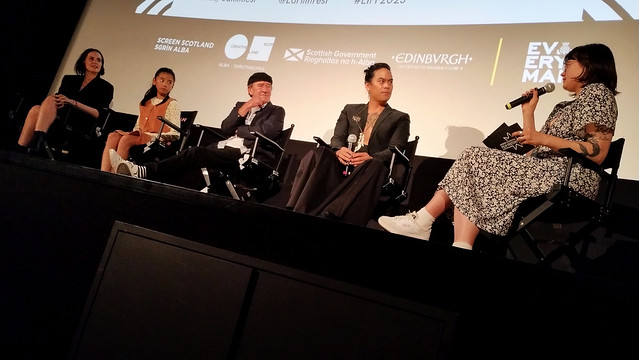
(Director Paris Zircalla with some of his cast, on stage after the EIFF screening, pic from my Flickr)

This was one of the EIFF screenings I really wanted to catch, and it did not disappoint, with some amazing performances from the small cast (young Jaden stealing many scenes as Grace), and beautifully shot, making the best use of that large, creaking old country home location, mixing horror and drama. The subtexts about past colonialism and echoes in modern day exploitation of immigrants is well done and powerful, and as the director remarked at a Q&A after the screening, much of what was seen on screen is drawn from what many experience in their day to day lives, and it is something that applies not just to the immigrant experience but across society, where those in the poorer-paid jobs are often badly treated and seen as disposable. A brilliant, Gothic-tinged horror-drama with some serious social commentary woven into its structure.

This review was originally penned for Live For Films

FrightFest – To Fire You Come At Last

FrightFest 2023 – To Fire You Come At Last,
Directed by Sean Hogan,
Starring Mark Carlisle, James Swanton, Richard Rowden, Harry Roebuck, Stephen Smith,
Severin FIlms

Debuting at this year’s recent FrightFest, Sean Hogan’s To Fire You Come At Last may be short, but it certainly delivers, drawing on the influence of classic British folk-horror movies. It’s a nice, clean, simple set-up: Mallow, the local squire (Mark Carlisle) and his manservant Pike (Richard Rowden) have enlisted Holt (Harry Roebuck) to arrange the carrying of the coffin of the squire’s son Aldis (Stephen Smith), Holt having been his best friend. The squire has sent his man to obtain villagers to carry the coffin across the moors to the church, but none want to come, as the moors (of course!) have an evil reputation for witches and mysterious black dogs that signify impending death (shades of the old Black Shuck legend). All they can get is Ransley, a local drunk and ne’er do well, forcing the squire to also assist in the carrying of the casket.

It’s against this backdrop of lonely moorland our four men set out with their macabre burden, Holt warning that with only four of them they will not likely make the churchyard before dusk, and they really don’t want to be caught on the moors after dark. The squire arrogantly chides him for foolishness and superstition, and the four continue, but Holt is correct, darkness falls while they are still treading this lonely, rural path, the blackness of the countryside at night, dispelled only in small pools of light around them from their lanterns.

And they start to hear noises – is that a dog growling somewhere in the gloom? Footsteps? As the darkness and thoughts of local folklore play on their nerves, the men bicker among themselves, and soon accusation are flying too – connections each had to the deceased (even the lowly drunk, Ransley), until it seems they have all committed sins that may leave them vulnerable to Damnation, and therefore ripe for the picking for whatever dark, supernatural forces roam the moorland at night. Except the squire, who insists he is a good, upright man (so you just know this arrogant aristocrat is hiding a secret!).

This short film is split into four acts, each slowly ratcheting up the tension rather splendidly. It’s shot in a crisp black and white, which is particularly effective once night falls – four figures burdened by a wooden coffin, illuminated only by carrying lanterns, the world around them almost invisible, black darkness, the odd skeletal tree coming into view as the lamp light reaches it, the only other features the stars in the nocturnal skies above them. It’s a great choice, aesthetically (props to cinematographers Paul Goodwin and Jim Hinson), giving the film a simple but very effective look, and it also works well for a small budget, enhancing the look of the film without the need for expensive sets or locations to match the 17th century period.

A highly effective, atmospheric short that draws on the fine Brit folk-horror tradition.

This review was originally penned for Live For Films

Edinburgh International Film Festival – Animated Shorts Review

Edinburgh International Film Festival – Animated Shorts

The Edinburgh International Film Festival was much shorter than usual this year – given last autumn we thought we had lost it along with the Edinburgh Filmhouse when the charity running both went into administration (see our report here) though, I was just grateful the world’s longest, continually running film festival was still going. We didn’t have the annual McLaren Animation Awards this year, but I was relieved to see that the EIFF programmers still made space for the animated short films, with a mix of familiar faces and new talent, with a dozen films, taking in a diverse array of subjects and styles, from hand-drawn to using found objects, stop-motion, even fragments of vinyl album sleeves to create their worlds.

I will hold my hand up here and admit my bias – as readers of our previous years of EIFF coverage will have gathered, the short animation strand is pretty much my favourite art of the film festival. In one screening it encapsulates – at least for me – what these festival should do: expose the viewer to a mixture of established and emerging talent, give them that important showcase, and take in a variety of styles and subjects. Isn’t that part of what we want at a film festival? That chance to explore works we might not otherwise see?

Jenny Jokela’s Sweet Like Lemons, a play on the old “if life gives you lemons, make lemonade” phrase, used a colourful, hand-drawn style to explore issues of toxic relationships, and trying to extricate yourself from them. We see hands trying to write an email, constantly starting the message, then deleting it, starting again, and again, because she’s trying to find the determination to break free from a cycle of behaviour and find herself. The artwork veers from colourful and beautiful to the suddenly threatening, mirroring such controlling relationships, and felt very from the heart.

Sweet Like Lemons (2023) – Trailer from Jenny Jokela on Vimeo.

Some of the other works were also clearly drawing (sometimes literally) on personal experiences, using the animation medium to explore their own emotional history and experiences, articulate them, perhaps learn and grow beyond them, or at least have some closure and ownership over those issues, instead of letting those issues own them (not to mention sharing with others, some of whom may have experienced similar, and may gain recognition and strength from the sharing, never a bad thing).

On that score, I thought Holly Summerson’s Living With It, and The Perpetrators by Richard Squires both used animation as a way to explore their own lives and struggles. In Living With It, another traditionally, hand-drawn animated work, Summerson takes the reality TV show idea of the home makeover, except in her case her home and world are run down and in need of an uplift because she lives with a chronic illness, manifested as the character Bug. It’s a brief but emotionally effective glimpse into a life too many have to cope with.

Living With It – Trailer [CC] from Holly Summerson on Vimeo.

Perpetrators mixed live action footage with animation, exploring how it was to grow up as a gay man in the hostile environment of the 1980s. The framing device is using changing medical and psychological definitions of homosexuality (still on the books as a mental illness until just a few decades ago). The pain and shame of having to be hidden, not to be able to declare who you are to friends or even close family, is palpable, the institutional nature of the bigotry shameful to modern eyes (consider how similar tropes are deployed today in the debate around trans rights). But Squires also deploys a lot of humour here, using tropes from the much-loved Scooby Doo cartoons to inform his animation. I suspect that streak of humour was, for him, as for many of us, part of how he coped (what would we do without that sense of humour? How much darker would our lives be?).

Tanya J Scott’s The Wolf of Custer was a beautiful piece, exploring the power of folklore and myth, as a hunter, reminiscent of Quint in Jaws, listens to the people of a small town tell tales of a giant wolf that can devour entire bisons (the smoke and flame of a fire and the shadows in the room all morph into flowing, dream-like images of the magical wolf as they tell their tales). Arrogantly he declares where would we be if we believed such native folklore nonsense, and that he will set out to kill their wolf. As you may imagine, as his journey through the vast wilderness progresses, and he catches glimpses of the wolf, then images of it carved and painted into the rocks of the very land, he slowly comes to realise and respect why we have such creatures in our stories, why they are important to us.

Jordan Antonowicz-Behnan’s A Taste For Music dealt with living with a seriously ill loved one, in this case his father. It captures that frustration at seeing them being weakened and unable to do things they want, and is also quite honest about the anger and resentment that comes along with this as it grinds on (many of us will have been there, with the best will in the world there’s a moment where you just become so angry at the situation, the disease, even the person). Through it though is a shared love of music, drawing – quite literally here, the animator drew on record sleeves – on his father’s extensive vinyl collection as a way of connecting, something the illness could still allow him to do, while the use of record sleeves gives the visuals a distinctive flair.

A Taste For Music (Trailer) from Jordan Antonowicz-Behnan on Vimeo.

I was also delighted to see BAFTA-winning Ainslie Henderson return. I’ve seen Henderson several times at the McLaren Animation strand at the EIFF over the years – his film A Cat Named Dom won last year’s McLaren gong at the festival (see our report from the 2022 EIFF here on LFF), and am always looking forward to any new work. Shackle is a stop-motion piece (I love all animation, but have an especially soft spot for stop-motion work), with a couple of small woodland creatures, taking everyday forest objects such as apples and pine cones, then making art and music with them, while a more frightening version of these endearing creatures lurks in the dark version of the forest, looking on greedily and coveting what they have.

I don’t really have time to dive into every film screened during the Animated Shorts, but these are some of the ones that especially caught my eye. Again I am grateful the animators get a chance to show these in a cinema setting, with an audience, and talk about their works – we used to have the excellent Four Mations on Channel 4, and BBC2 used to do late night animation strands, years ago, something that seems to have vanished from media schedules these days, despite the phttps://www.liveforfilm.com/roliferation of more channels and the fact we’re still seeing new and established talents creating new, interesting works, but the main broadcasters seem to ignore them, which, I think, makes the film festivals all the more important as a chance to wave the flag for this time-consuming and inventive form of film-making.

This review was originally penned for Live For Films

Edinburgh International Film Festival – Art College 1994

Edinburgh International Film Festival 2023 – Art School 1994
Directed by Liu Jian,
Starring the voices of Jia Zhangke, Zheng Dasheng, Xu Lei, Wang Hongwei, Peng Lei, Ren Ke, Xu Zhiyuan, Shen Lihui

This animated film from China took around five years to complete, so one of the film festival programmers told us before the screening, drawn in the more traditional 2D animation style, which is, of course, very labour-intensive, yet often worth it for the distinctive aesthetic and feel it can give. In the case of this Chinese, animated slacker film (there’s a phrase I have never used before!), it also suits the tone of the film and the characters very well.

Set, as you may infer from the title, in the mid-90s, the film follows the lives of a group of students at a small, but well-regarded art college in China,  Zang Xiojun (Dong Zijian) and Rabbit (Chizi) are the main focus of the film, Zang with his floppy hair and the permanently attached earphones for his music (a cassette Walkman) is more the unfocused dreamer of the group, listening to bootleg Nirvana cassettes, stifled by the insistence of his tutors that he adhere to classical styles instead of exploring new ideas (which you’d expect to be encouraged in an art college, but not here, in China of 1994, where modern Western art movements are especially reviled).

Rabbit is more pragmatic – at least when not pondering out loud on second hand philosophy he’s picked up from bits of books and hasn’t actually thought out. A bit lazier, when he does focus he is more likely to be thinking about how his degree will get him a decent paying job, how he’d like to be famous (because then “he wouldn’t have to actually paint much”, thinking about a girlfriend. It’s not that Zang doesn’t consider these things, he even joins the odd philosophic musing over beer and cigarettes, but he is far more into considering what is art, and how he can do something that is new and interesting to him in a world where it feels like so many earlier artists have done all the innovation already (at one point he even burns a pile of his art, which a more pretentious artist takes as an actual artistic piece in itself).

The film moves at a gentle pace, and the remaining cast of friends and classmates, each dealing with their studies, their hopes for the future, dreams of what they could be and want to be, versus what the world of the time will likely actually let them be, is one many of us will find very familiar. Small-town Chinese art college in the 90s, perhaps, but there is so much that is just universal there that, despite the language, it feels very familiar, and had me thinking back to my own college days and blushing to think there would be nights in our student gaffe where I or my friends would be those characters, drinking cheap booze, holding forth on what we thought were well-considered, mature, informed Great Insights, which in retrospect were hopelessly naive, because, despite thinking we were mature, we really hadn’t experienced much life yet, not really, and understood even less of it, but we were still filled with that longing for an imagined future we thought we’d make where others failed.

The 2D animation was worth those years of effort and labour; this just wouldn’t feel the same in CG animation (although there is a small use of CG for some backgrounds). Aside from the longing to shape some perfect life that will fulfil us after graduation, the film also muses on art and the nature of what art actually is, and who decides it is art or not, with one character declaring anything can be art. Jian seems to incorporate this into the animation itself, with frequent small asides that focus on something away from the characters, be it shimmering water below a bridge, a beetle trying to climb a wall, the way paint slowly peels from the wall.

This is a film that, despite being another country and culture, fits in perfectly with the likes of some Western slacker films (such as Linklater), because the youthful fears and dreams are pretty universal to most people, in any country, in any time.

This review was originally penned for Live For Films

Edinburgh International Film Festival – Tokyo Pop

Edinburgh International Film Festival 2023 – Tokyo Pop,
Directed by Fran Rubel Kuzui,
Starring Carrie Hamilton, Diamond Yukai (aka Yutaka Tadokoro), Hiroshi Kobayashi, Hiroshi Sugita, Satoshi Kanai, Rome Kanda

The Edinburgh film fest usually includes some retrospectives of older films, as well as showcasing new work, and even with the very slimmed down festival we’re having this August (after us almost losing the festival last autumn, as we covered, I’m just grateful we have it at all, frankly) there was still room for some older gems, including this 1980s piece, which somehow I had never come across before.

Tokyo Pop, created in 1988, was the first directing gig for Fran Rubel Kuzui, who I am sure many of you will know for her association with Buffy the Vampire Slayer and Angel, and Fran was at the festival, talking with the audience after the screening, explaining at one point how damned hard it was for a woman to become a Hollywood director back in the 80s, even on a small budget, Indy film (the gender ratio is still bad today, but back then, even worse).

It’s a deceptively simple story – an American woman, Wendy Reed (the late Carrie Hamilton) is fed up with being relegated to backing singer duties by useless rock and roll boyfriends in 80s New York. When a postcard from Japan arrives from her friend who is staying there, saying “wish you were here”, and adding that the Japanese youth love American rock culture, she decides to take her friend at her word and go there, with no plan, no skill in Japanese, not even a map of Tokyo, just a vague plan of becoming a music star there.

The cultural fish out of water scenario is compounded when she arrives to find her friend has already moved on and is now in Bangkok, leaving her trying desperately to find somewhere to stay and to get a job so she can get some money. Her “exotic” gaijin (foreigner) looks help her get a job in a hostess bar – it helps pay the bills, but it’s not exactly the rock and roll fame she was seeking. Meanwhile Hiro (actor and rock star Diamond Yukai) and his band is struggling to get noticed by the local big producer or land paying gigs.

Their first encounter with Wendy goes badly when Hiro’s less than expert grasp at English leads him to misunderstand the situation when she tells him she needs a hotel for the night, and he thinks she means one of the city’s many “love hotels”. Such comic misunderstandings are part and parcel of this kind of tale, and we all know that sooner or later they are going to become close, and that she will be the thing that makes their band stand out, especially in an 80s Japan that was always hungry for new fads.


In some ways Tokyo Pop is of its time – this was the 1980s, and this would fit nicely into an evening of 80s viewing with some John Hughes flicks, and of course the styles and music mark the era. And yet at the same time it feels very fresh – it’s that cultural misunderstanding Schick which is still funny (and goes both way, not just her ignorance of Japan, but the Japanese characters attempting Western rock without really understanding it). It’s a bit drama, it’s a bit romantic-comedy, it’s a bit musical, but mostly it is just a charming delight of a film, the two main leads radiating that youthful, naïve confidence, lighting the screen up with huge smiles and a tremendous sense of fun and pure charm. A total delight, now restored into 4k.

This review was originally penned for Live For Films

Edinburgh International Film Festival - Fran Rubel Kuzui 03
(Co-writer and director Fran Rubel Kuzui talking to the Edinburgh film fest audience – pic from my Flickr)

Edinburgh Film Festival – Superposition

Edinburgh International Film Festival 2023 – Superposition
Directed by Karoline Lyngbye,
Starring Marie Bach Hansen, Mikkel Boe Følsgaard, Mihlo Olsen
(Danish language, with English subtitles)

Stine (Marie Bach Hansen), a frustrated writer, and her partner Teit (Mikkel Boe Følsgaard), a broadcaster and podcaster, have decided to quit the rat race of life in urban Copenhagen, and are moving with their young boy, Nemo (Mihlo Olsen), to try living for a year completely isolated in a designer cabin, near a lake in the Swedish forest, with Stine planning to use the peace and space to get back to her novel, while Teit is recording regular podcasts on their experiences, although since they are too remote for any web access, he has to put his shows on a USB drive then mail them to his radio station and the people bankrolling their lifestyle change. It will not surprise anyone to learn that their plans to not go quite as expected, and they start to learn more about one another than they anticipated – in a rather unusual way.

Right from the beginning there’s a lovely visual style to Superposition by cinematographer Sine Vadstrup Brooker, with a view of the calm lake waters, the line of the opposite shore bisecting the middle of the screen, the water reflecting the trees and the clouds above, but tilted ninety degrees to the side, slowly rotating back to the more normal viewpoint; a beautiful image, but also one that whispers of something not right, something being out of kilter, in this remote location.

At first they settle in quite happily, exploring the very cool, designer cabin and surrounding woods and lake, their wee boy and dog, Tarzan, happily running around while they settle in. As Tein sets up the microphones for his first recording, however, the cracks start to appear, as an at-first genial discussion between him and Stine about why they came here and what they hope to get out of it, produces answers Tein isn’t too happy with. Stine points out that they agreed to be honest in these recorded discussions, something he likes to pride himself on, but we can already see that actually he’s quite sensitive to honesty when it concerns him.

This is all handled in a nice, quiet, intimate manner between the two characters, no histrionics, no shouting. It’s also a nice bit of storytelling economy – we get the gist of their relationship and troubles (he had an affair, cheating on her, she resents giving up her plans to be the Great Young Novelist she was earmarked by the writing establishment to become in favour of raising a family) in one short scene, along with the obvious fact that both are also creatives and seem a bit competitive on that front as well as on their personal relationship. It’s deftly done, no flashbacks or long expositions, we get it all in this quiet, neat way, letting us into the characters and their lives.

So far you could be mistaken for thinking this is going to be one of those films where people with troubles escape into nature and find the struggle to live in it helps them put their personal problems in perspective, and overcome them. But this is more “glamping” than really back to nature, whatever the pair of them think (fancy cabin, electricity, computers, music, wine, hardly roughing it). And there is something else going on – they glimpse another family of three, on the far shore of the lake.

This surprises them as the location was sold as being totally remote, with no-one else near them. Stine in particular seems very put out by this (given the vast spaces around them, it’s hard to feel any sympathy for her here, she seems more petulant than anything else). They try to avoid these others, which should be easy as they are away on the other side of the water, but of course, we know sooner or later something will bring them in contact with one another. And when they find these others are, well, them, they are understandably confused. Why are dopplegangers of them here in this remote forest? Where did they come from, what do they do?

Edinburgh International Film Festival - Karoline Lyngbye 02
(Director Karoline Lyngbye, on the right, talking to the film festival audience, pic from my Flickr)

Although you can see little hints of the likes of Peele’s Us, this is a different beast, and uses this encounter to further explore the damaged relationships between the main couple in a rather novel way. Starting as a drama, Superposition mixes in elements of science fiction, thriller and horror into its DNA, and combines it with some lovely cinematography (riffing cleverly on reflections and duos), while scenes with the characters interacting with their duplicates are very well done (the director explained they had some of the visual effects team on hand during the actual filming to make sure it was done right, a laborious task involving multiple takes of scenes).

An intriguing, clever and beautifully shot piece of cinema from Denmark.

This review was originally penned for Live For Films