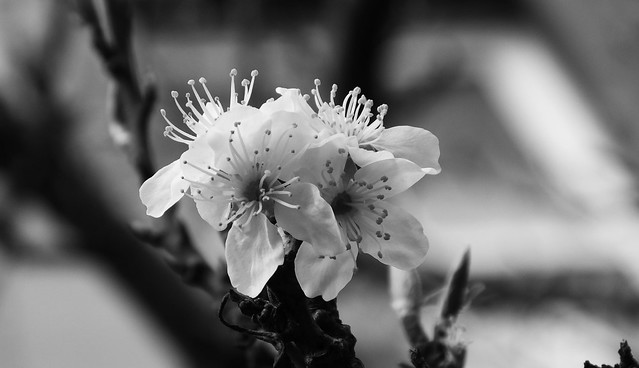
Vibrantly coloured flowers, pushing through a garden fence, spotted on the walk home from work, part of the petals catching the golden, evening sunlight, the rest in shade, some raindrops from earlier in the day still visible. Quick snap with the phone camera.
The other weekend was the start of the Edinburgh Jazz and Blues Festival (next month sees the Edinburgh International Festival, Edinburgh Fringe, Edinburgh International Book Festival and the Edinburgh International Film Festival all take place – summer is festival city time here). As usual the Jazz and Blues fest kicked off with the Carnival. Unlike previous years it didn’t go down Princes Street, and instead was all within the West Princes Street Gardens (I’m guessing to avoid shutting down the tram network now).
As usual I took far too many photos (these are just a few), but hey, it’s a wonderful occassion and it marks the real beginning of summer and the the festival season here, and I got to watch it all with a dear chum, which always makes these things better.
The weather forecast predicted showers, but we got lucky, it stayed dry and at some points the sun even came out as if to admire the colours and costumes and smiles.
As ever there were some fabulous costumes, colours, music and smiles from all around the world.
Here we have a gentle and charming documentary, and on a subject very close to my heart – a local bookshop. Matt Tannenbaum has owned The Bookstore in Lennox, Massachusetts, since the mid-1970s. The Bookstore is a lovely-looking independent bookshop, they type I think many of us who are book-lovers adore – an eclectic mix of titles assembled by the booksellers, piles on tables and corners, unusual books rubbing shoulders with popular, bestselling fiction, the sort of place you can happily spend several hours browsing in.
This is a world I know very well – I’ve been a bookseller for over three decades now, and am fortunate enough to work in a small (but mighty, not to mention award-winning) bookshop, which like Matt’s is far more than a business, it’s a special place in the community. Regulars come in as much for a book browse or reading recommendation as they do a wee chat. Parents can have a nice browse for their own books because the kids are happily sitting in a corner of the children’s section, noses stuck in books, the world beyond forgotten, swapped for the land of words and stories.
Indy bookselling, indeed independent small retailing of any kind, is often precarious – you have limited resources, compared to large company chain-run stores, these days there’s the competition from online (especially a certain river-named site), it can be tough going. But one of the critical differences between many Indy bookshops and big company chains or online is that they are often located in local communities. That’s a crucial factor – they are important places for many of the locals. Like the local pub or coffee shop, they are there as a business, yes, but they are also a hub where people meet, a safe space to relax, those who work there know many of the customers by name and can offer up personal recommendations for adults and younger readers alike.
And when times get even tougher, as they did during Covid, that community aspect is vital. We see Matt and his friends doing what many of us did, trying to keep things running in some form during all the restrictions of the Pandemic, taking orders over the phone or email, or serving people in the doorway (when it wasn’t safe for them to come inside and browse). Like many businesses, we went through the same – having to be closed for a while, then allowed to do a “click and collect” service from the doorway. It allowed some sales, although far less than normal, but it also offered a lifeline to locals; with so many places closed, people stuck at home and only able to walk a short distance during restrictions, being able to ring the local wee bookshop and pick up from there was a great thing in a hard time.
And that’s where the community aspect comes in again – because that same community appreciates all the local bookshop gives, and as it struggles increasingly during the Covid restrictions, rallies around to support that bookshop, to ensure its survival. We’ve all seen the decline of high streets in towns and cities around the world, far too many are full of empty units where there used to be numerous independently owned shops. The old adage of “use it or lose it” is true, if we don’t use those locals businesses, we end up with dead high streets and reliant on a few big chains and online. And clearly the readers of Lennox understand this, because they support The Bookshop through its toughest times, because this is a place they want to keep in their community.
The documentary itself is a gentle delight, taking some scenes through the seasons, intercut with Matt chatting with regulars, reading quotes from some of his favourite works, talking about how he first got into bookselling (he talks about a friend after his navy service, turning him onto Kerouac, Mailer and more and how the then “fell in love with writing”). It’s another aspect of the trade I am very familiar with – few people are in the book trade to make big money; booksellers, distributors, writers (unless you are fortunate enough to become a Stephen King or Ian Rankin or J.K. Rowling) rarely make a lot, they are in it because, well, they love books, they love stories. And there is something rather wonderful about that, which Zax showcases beautifully here. This is just a charming, lovely watch, especially for those of us who are forever in love with the written word and those lovely, tome-lined emporiums where we can find them.
Hello, Bookstore is out now in some cinemas and on demand from Bulldog Film Distribution
She Came From the Woods,
Directed by Erik Bloomquist,
Starring Cara Buono, Clare Foley, Spencer List, Michael Park and William Sadler
It’s the 1980s, and young camp counsellors in very 80s tight shorts and T-shirts are making the most of the last night of summer camp, when the seasonal frolicking and hi-jinks suddenly take a sinister and bloody turn, leading to multiple mutilations and deaths. If that sounds like a very familiar scenario then yes, it is – quite deliberately. Erik Bloomquist and writing partner Carson Bloomquist clearly loved those now-classic 1980s camp-set slasher movies, of which there seemed to be an endless wave of in the local video stores (although, of course, Friday the 13th remains the standard-bearer).
I grew up with those films, the bastard video sons of Carpenter’s Halloween, and I still have a lot of love for them, but they did run their course until the tank was well-dry (and in some cases beyond), eventually playing themselves out, leaving themselves more as memories and markers in horror film history, and, frequently (and sometimes deservedly) ammunition for parodies and spoofs. And yes, there is a reason that sub-genre became played out and parodied, but by the same token, there’s also a reason why those early films in that genre were fun and made an impact, and I get the impression the Bloomquists are thinking along the same lines, and thus comes She Came From the Woods, which isn’t really a parody, or that dreaded thing, the Reboot, but rather a film made by people who loved those kinds of genre flicks, realised they don’t really get made any longer and thought, surely we can do something in that line that would still work.
The camp counsellors – the usual mix of the Responsible One, the Sexy One, the Dorky One, the Asshat One – have a bit of a tradition of holding a ceremony on the final night of camp, out in the woods, meant to call the spirit of a mad, murdering camp nurse who legend has it went berserk decades before, killing many kids and counsellors. It’s a joke, a bit of fun as their summer working together comes to an end and a return to the regular world calls.
Except this time it looks like the ritual has actually summoned something back, and soon people are being picked off in a variety of gruesome ways.
I’m not going to go deep in the nuts and bolts of it here – anyone interested in this love-letter to the camp slasher film surely knows the standard format of the story by now! But suffice to say, the Bloomquists do this with a lot of love for those iconic 80s slashers – there is a nod and a wink to fans, well-versed in the tropes and norms of those movies and characters, but it is laughing with us and the genre, not at it. We’re really having our cake and eating it here, because we get an 80s style camp Slasherthon, but we also get to enjoy it in a very self-aware manner, so we can enjoy it as a return to that style of decades ago and lose ourselves in that as we munch the popcorn, but we are also aware of all they are doing, and the references they are making.
If you were never a slasher movie fan, it’s unlikely to convert you, but for those of us who grabbed all those films off the local video store shelves at weekends to watch with friends, this is a a hugely enjoyable trip back to that style of horror, made by creators and actors who obviously know those films and have a lot of love for them.
She Came From the Woods is out now on Digital via Blue Finch Film Releasing
The start of June saw our Cymera Festival of literary science fiction, fantasy and horror return for its fifth year (only third time in person as we had to do two years on Zoom during the Covid Lockdowns, of course), and, as usual I was there (and also chairing), and the camera was with me as usual.
Alice Tarbuck in conversation with Juliet McKenna, Sharon Emmerichs and Claire North in the Pleasance Theatre
Nina Allan, Cory Doctorow and Ian McDonald on stage in the Pleasance Theatre. Was nice to catch up very briefly with Cory, not seen him in person in Edinburgh since an event as the old Pulp Fiction bookshop (now sadly long gone), over a decade ago.
Neil Williamson in conversation with Grace Curtis and Doug Johnstone. I’ve known Neil years, he’s a stalwart of the Scottish SF scene, and Doug is best known to readers for his Edinburgh-set crime novels, but this spring he released his first science fiction novel, the Space Between Us (also largely set in and around Edinburgh, before going on a road trip across Scotland)
Rhiannon Grist in conversation with Catriona Ward, Anya Bergman and Fiona Barnett in the Pleasance Theatre. I was fortunate enough to chair Anya at an event for our own bookshop a couple of weeks ago, and highly recommend her historical novel The Witches of Vardo, based on real court records of witch trial in Norway. Fiona wrote the Dark Between the Trees, a cracking, very spooky, atmosphere horror tale split between the Civil War era (Parliamentary soldiers ambushed and forced into the deep dark woods, where only two emerge with strange tales), and modern era as academics attempt to retrace their route to see if there is any evidence to support the survivor’s tale (it was one of my favourite reads last year).
C.L. Clark and Samantha Shannon on stage in the Pleasance Theatre
Peta Freestone chairing Amie Kaufman and L.R. Lam in the Pleasance Theatre. I was fortunate enough to chair a talk with L recently in our bookshop, discussing her new “sexy dragons” romantic fantasy (“romantasy”), Dragonfall, which I loved.
The Brave New Words strand returned – this is where new, emerging writers get a chance to do a reading from their new work before the start of one of the author panels, nice chance for them to be spotlit in front of an audience and encourage their work. Above: Lucy Elizabeth Allan reading, below – Robin C M Duncan
I was also on stage (so obviously I did not take pics of that one!), chairing a talk with Dave Cook, Mike Carey and Ever Dundas, which was great fun to do. I got to catch up with a bunch of friends over the long, sunny weekend, including some I hadn’t seen in ages, drink, food, chat, the Cymera Quiz, Shoreline of Infinity night and more. Terrific weekend.
And my chum James was there with his furry friend, Tabitha – I last saw Tabitha back in August at the Edinburgh International Book Festival (when she was much smaller!), here she was at Cymera, on James’s shoulder, or sometimes sitting behind his book table in the Creator’s Hall to help him sell his own books. Clearly she is a very literary puss!
I was fortunate enough to be asked again to chair an event, this year with Ever Dundas, Mike Carey and Dave Cook for their recent HellSans, Infinity Gate and Killtopia graphic novel series, respectively. As usual you go on the stage thinking “my god, we need to talk for a full hour”, before you know it the time is almost up and yu’ve not touched on several of your possible questions – happens that way every time. Of course I couldn’t take a snap of the event as I was on stage in the Pleasance Theatre with them, but this is the authors signing after the event:
I study nuclear science
I love my classes
I got a crazy teacher
He wears dark glasses
Things are going great, and they’re only getting better
I’m doing alright, getting good grades
The future’s so bright, I gotta wear shades
I gotta wear shades
I’ve got a job waiting for my graduation
Fifty thou a year’ll buy a lot of beer
Things are going great, and they’re only getting better
I’m doing alright, getting good grades
The future’s so bright, I gotta wear shades
I gotta wear shades
Well I’m heavenly blessed and worldly wise
I’m a peeping-tom techie with x-ray eyes
Things are going great, and they’re only getting better
I’m doing alright, getting good grades
The future’s so bright, I gotta wear shades
I gotta wear shades
Timbuk3.
People watching along the Union Canal on a very warm, sunny, spring evening, so many people in sunglasses, which always makes me think of the classic 80s pop song, “Future’s So Bright, I Gotta Wear Shades” by Timbuk3.
I finally got to visit the new V&A museum and gallery which opened on the riverfront of Dundee recently, which included an enjoyable train trip up from Edinburgh, which takes you across both the massive Forth Rail Bridge and the Tay Rail Bridge to cross both huge firths. The Tay Bridge, while not enjoying the iconic status of its southern cousin on the Forth, has an eerie side to it – as you cross, if you look out the south side of the structure you can clearly see the line of the remnants of piers, which once held up the first Tay Rail Bridge.
I snapped these two out of the train window, so they’re not the sharpest
That bridge was an engineering marvel of the age, the designer was knighted for his works, Queen Victoria even travelled over it returning on the Royal Train from a stay at Balmoral. However on December 28th, 1878, a huge, gale-force winter storm struck the Tay, and it transpired that it hadn’t really been designed to take that force hitting side-on to bridge and train. A passenger train was lost as the bridge collapsed, taking sections of bridge and the train with it, seventy five people plunging into the cold waters below, all lost. The replacement bridge runs right alongside the original’s route, but was, as you can imagine, built to be far sturdier, and remains in service to this day. The remnants of the first bridge’s piers now remain like tombstones, a ghostly reminder to all who cross the bridge of the one that was there before.
The V&A Dundee is a striking building, right on the riverfront, next to the famous polar exploration vessel Discovery and its own museum, and right across from the train station, so pretty perfect for visitors to the city.
It’s an impressive space inside, two main wings, with a lot of open space, windows often giving sudden glimpses of the bridge, the silvery Tay (the most powerful river in the British Isles) and the tall ship, Discovery.
There are permanent exhibits, many global, but also a good selection that reflects the culture, arts, crafts, industrial, scientific and engineering history of Scotland, with some there drawn from its host city Dundee’s own history, as well as travelling exhibitions (the current one is on tartans).
(above: the Oak Room designed by the great Charles Rennie Mackintosh for Miss Cranston’s tea rooms. Below: the Kinloss Psalter, a beautiful illuminated work though to date from between 1500 – 1530 CE)
Enter the Gateway to Infinity! Okay, actually this is me standing directly under the Tay Road Bridge in Dundee, zooming the lens through the large piers supporting this very long structure, which I thought gave a very cool effect, especially in black and white:
Walking home from my book group recently, darkness had just fallen. I didn’t have my main tripod with me, but did have my wee Gorilla mini-tripod, with its bendy legs, and thought some scenes of people waiting for the evening trams in Saint Andrew Square would look good in monochrome, so I sat the mini-tripod on a handy post to raise it up, set the timer and crossed my fingers…
As I was zooming in more on the people waiting on the platform, I heard the rumbling of an approaching tram, so I left the camera on a long exposure, so you get that nice contrast between the stationary platform and people standing still, and the blurred motion of the tram passing them, which I quite liked:
A second tram arrived while I was still shooting, so I got a twin-tram snap for the last pic. Not the greatest, but not bad for semi-improvised night shots. As ever, for the larger versions, click on the pics to see them on the Woolamaloo Flickr stream.
I switched back to shooting in colour for this pic, just a couple of moments walk from the previous ones, looking towards the buildings on the south side of Saint Andrew Square, but also managed to get one of the cherry blossom trees into frame, the branches loaded with sakura, hanging over the railings of the now-closed gardens:
Some huge cranes were catching the evening light recently, which drew my roving eye to take a few snaps, zooming in closer until it looked like giant Meccano sets in the sky. The declining evening sunlight also made them cast enormous shadows onto some of the modern buildings at the end of the Union Canal too, which was just begging for some monochrome shots.
As April trundles on, we’ve had the usual mix of weather in Scotland, from beautiful, warm (ish), sunny spring days to howling wind, grey skies, rain and temeperatures suddenly dropping back to feel like February. We do get a variety here… Regardless, nature carries on to her own timetable, and there have been welcome signs that, despite bursts of colder weather, spring is settling in, and bringing with it a rebirth of colour.
I loved these white Daffies with the yellow centre, catching the evening light in the old boneyard of Dalry Cemetery
The cherry blossoms are coming out too – although it varies all over the city. Some have had petals blooming for a couple of weeks or more, others are barely starting to bud, others again are in almost full bloom. It’s remarkable how much it varies across the town.
I found this fallen bloom on the pavement, fallen from a vine running along a garden wall, covered in raindrops, the soft, silken petals in stark contrast to the hard, dark of the asphalt paving.
The Daffies, as ever, provide a wonderful burst of colour after the long, dark, winter months, like miniature, floral sunbursts
I’ve a long-standing love for jazz, and for Noir, so when an advance copy of Jake Lamarr’s “Jazz Noir” landed at our bookshop, my colleague thought of me right away, and she was right! Covering Harlem from the mid 1930s to the early 1960s, we follow Clyde Morton, who is soon given the moniker “Viper” (not so much for cold-blooded, snake-like behaviour, it’s the hissing sound as he takes a drag on a reefer, the drug of choice of the jazz musicians in Harlem.
We first meet Viper in the 60s, and in flashbacks we get his earlier life – convinced by an old uncle that he can be a great musician, he eventually leaves his home in the rural South to head for New York, just another wide-eyed rub in the big city, ending up in Harlem, drinking in the vibrant African American culture, especially the music of the era, jazz. He is soon disabused of his ideas of musicianship by a friendly but honest musician who runs the shows at a busy venue, who tells him the unvarnished truth – he’s terrible.
But he does help him get an entry-level job, and he soon catch the eye of Mr O, the big boss who runs the club and the drugs sold there, and it isn’t long before he works his way up the ranks, from the muscle to a rusted lieutenant and higher. He also earns a reputation that ensures that nobody will mess with him, in the best Hard Boiled tradition, and we see this take place in the multiple flashbacks from the older Viper, reflecting on the path of his life from the 1960s, as the world has changed around him, and, while enjoying success he’s not sure he’s truly found happiness.
While the story of Viper is engrossing, it’s the atmosphere Lamarr conjures which really draws you right into the book. Right from Viper’s first arrival as the country boy amazed by the big city – not just the size and the bustle of it all, he’s not used to seeing and hearing much of the culture from African-American people, and here it is, the beating heart of it in the 30s Harlem. He even sees a black police officer, which is astonishing to this young man from the Deep South.
As we follow Viper through the decades, we see the world change around him – forced into wartime service, he returns in 1945 to find things different. The jazz scene may still be king, but mainstream white culture has been appropriating it, with busy clubs in different parts of the city, where once they all came to Harlem, although Harlem is still the heart of it, and the African-American musicians all come back to the clubs there after playing the white clubs in Midtown and elsewhere.
The music itself has changed – the Big Band era is giving way to Bepop and new styles, there are different strains of weed being smoked, but also heroin (the drug that would eventually kill Charlie Parker), which Viper refuses to sell. Real characters like Theolonius Monk, Duke Ellington and Miles Davis appear – you don’t have to be a jazz fan to follow the main narrative, these real historical figures are largely background, but if you are a jazz fan it adds to the atmosphere, and also to the feel of the world changing around Viper, as the music and the musicians (who rely on him for their drugs) change.
And of course there’s a woman – in Noir there is always a woman, and that woman is often a mix of alluring, irresistible and may also lead to disaster. Viper keeps himself in tight control, but sometimes there’s a woman you just can’t quite get over no matter what happens. An excellent, jazz-infused Noir, dripping with atmosphere.
Viper’s Dream is published by No Exit Press on the 20th of April