Reviews: Sea Fever

Sea Fever,
Directed by Neasa Hardiman,
Starring Connie Nielsen, Hermione Corfield, Dougray Scott, Olwen Fouéré, Jack Hickey, Ardalan Esmaili, Elie Bouakaze

After the film festival circuit – including a debut at the prestigious Toronto International Film Festival in 2019 – Neasa Hardiman’s Indy Irish horror movie arrives on DVD, Blu-Ray and on-demand from this week. Siobhán (Hermione Corfield), is a marine biology student, and one who really isn’t a people-person (as we see right at the start, as her classmates pause in the lab to celebrate a birthday, despite warm invitations to join in, she remains aloof). She is reluctant to undertake a required field work segment of her course, but her tutor tells her firmly she has to get out of the lab and get her hands dirty. To this end she’s booked aboard a trawler for a few days, to examine their catch, looking for pattens and irregularities in the marine life.

The ship is captained by the grizzled, taciturn Gerard (Scots actor Dougray Scott essaying an Irish accent), and owned by his partner Freya (Wonder Woman’s Connie Nielsen), and they are glad of the money the university contract brings – like many independent trawlers the wolf is never far from the door. There is some reluctance from the crew, partly at having someone onboard who isn’t a sailor, let alone experienced on the hard life of the trawler ships, and her stand-offish behaviour doesn’t help, nor does the fact she is a redhead (seen a bad luck on a ship, although interestingly I noticed there was no mention of the other old superstition of a woman being bad luck aboard – in fact with Hermione there are now three women on the ship).

The ship is warned by the coastguard that they cannot continue to the spot they originally planned to trawl, a potentially rich source of fish, that the area is currently off-limits as whales and their calves are in that zone. Unknown to the crew or authorities, Freya and Gerard make the decision to cut through this forbidden zone anyway. Of course any seasoned horror buff will know that going into a forbidden zone is the equivalent of leaving the path in the deep, dark forest in a fairy tale – you don’t do it, and if you do, expect trouble…

The trouble arrives fairly swiftly – something strikes the trawler, despite it being in deep ocean waters. And then they notice some very peculiar shapes forming on the planking of the wooden hull’s interior, deforming the thick wood, softening it – prodding it with a pencil, it goes right through, letting water in and revealing a glimpse of… something. Siobhán had planned a diving session as part of her field work, and at Gerard’s suggestions she reluctantly dives to investigate whatever has been striking the hull, finding something she never expected, an unknown creature, huge and glowing with bioluminescence, its long tendrils attaching to the hull. Is it attacking them, or has it just mistaken the ship for normal prey, in the way sharks sometimes bite surfers or divers, mistaking them for seals?

I thought this was the point where Sea Fever became far more interesting – especially given the situation we are all in at the moment, although that is just a lucky coincidence in timing – because until now it is giving the impression of a fairly standard monster movie. People go out on a normal, routine journey, encounter something unknown, it hunts them, they must fight to understand and survive. Except, no, it doesn’t go down that very well-worn route. Instead this becomes more about different types of life and their rights to exist, how they try to live (human and marine), and also, in what is now suddenly a very contemporary slant, about infection and controlling any potential spread from contact with unknown new organisms.

I wondered at first if this change in tack was down to budgetary restraints – an Indy movie like this simply can’t afford numerous, convincing effects scenes a full-on monster movie would demand. But I don’t think that’s it, I think Hardiman is more interested in people and their web of relationships, their interdependencies, and the way all of the elements, such as the sea, and other life (the fish, the whales, the unknown creature), how they react under sudden stress. I think it doesn’t quite hit the high mark it is aiming for, although again I think that may be due to the budget limitations Indy movie makers labour under, but nevertheless I found this to be a more unusual and far more interesting slant on the horror movie than I was expecting, and well worth checking out.

Sea Fever is available from Signature Entertainment on DVD, Blu-Ray and on-demand services from this week

Reviews: The Extraordinary Adventures Of Adele Blanc-Sec

Extraordinary Adventures Of Adele Blanc-Sec Volume 1,
Jacques Tardi,
Fantagraphics

And another Jacques Tardi piece I wrote for the now-defunct Forbidden Planet Blog, but somehow forgot to cross-post here on the Woolamaloo (in my defence I spent many of my own evenings writing or editing articles for the FP blog, unpaid, and didn’t have time or will to then do so on my own blog). So here below is my 2014 review of The Extraordinary Adventures Of Adele Blanc-Sec:

French creator Jacques Tardi has to be one of the most respected writer-artists working in comics, European or world-wide, and he is also a huge favourite of ours. Like Bryan Talbot he seems to have an uncanny ability to move through different mediums, adapting his art and style to suit all sorts of stories, from his early work back in the 60s in the famed Pilote comics magazine through adapting hard-boiled urban crime novels and his anger-fuelled, horror-filled World War One strips, but he has also created one of the great heroines of European comics, Adele Blanc-Sec, a writer by day, adventurer by night, Set in early 20th Century Paris, just a few years before the Great War, Adele stands out in an era when women were expected to ‘know their place’ in society, being a single woman of means, more intelligent and observant than the men around her and certainly far more adventurous.

Like Tintin she is an intrepid investigator of mysteries, and there is also something of the classic Scooby-Doo here as well in that there is often a fantasy or supernatural element (or at least seemingly supernatural – or is it??) to her stories. Fantagraphics have been translating and publishing Tardi’s works in English, to much acclaim, a series largely driven by Fantagraphics’ own Kim Thompson, not only a champion of quality comics work but also a multi-lingual editor, translating these works himself until his recent death (a major blow for both the publisher and the comics community in general). This first volume has been out of print for a while, but with a fresh print run on the way it seemed like a good time to turn our Classic Comic spotlight on to it.

This handsome hardback, full-colour volume actually boasts two stories in the one volume, collecting two of the original Adele Blanc-Sec albums, Pterror Over Paris and The Eiffel Tower Demon. Pterror introduces Adele to us and also the bizarre stories she can be caught up in, in this case a madcap science fiction tale worthy of a Victorian writer like Verne or even Conan-Doyle (in his Professor Challenger mode), in which a peculiar experiment, part palaeontology, part medical science, part mystical-mental ESP powers (a not uncommon theme for the era) combine in an attempt to resurrect a Pterodactyl from its millions of years of fossilised slumber. Those same mental powers which brought this extinct flying dinosaur back from pre-history are meant to guide it, but the animal instincts are too powerful and freed from it’s tomb the creature soars into the night-time skies of 1911 Paris and hunts on the wing, as it was meant to, bring terror – or ‘Pterror’ as the title puns – to the City of Lights, and drawing in both Adele and the bumbling police inspector Caponi (who became a regular character in the series).

What follows is a spectacular piece of high adventure as the incompetent police, scientists from the Museum of Natural History (where the Pterodactyl emerged from) and Adele all follow the trail of death and destruction left in the dinosaur’s wake, each with their own ideas and agenda. As well as superb Boy’s Own style adventure moments (the beast swoops down and rescues a man falsely accused of murder right off the guillotine scaffold) there are nice touches of humour (government minister calls head of police to complain who in turn calls his senior officer who calls his district chief who calls the unfortunate Caponi in a classic bit of bureaucratic pass-the-parcel). The second story offers a classic supernatural cult conspiracy tale, an elite of the city’s movers and shakers, hungry for ever more power (as those types often are), seek to bring back into our world the demon Pazuzu. But who is truly controlling this cult, and is the demonic monster we glimpse (even entering Adele’s nightmares) real or a front, just a control method to garner more power for some?

And the art throughout is glorious – Tardi creates and portrays a strong female lead character but doesn’t sexualise her – Adele is written and drawn as what she is, a strong, independent woman who knows her own mind and she isn’t waiting for some hero to come along, nor does she pine for romance. But away from the characters, there is also pure joy to be had in his depictions of early 20th century Paris. The scenes in the historic heart of this beautiful city are especially wonderful, because many of those locations are largely unchanged today. An opening scene in a wonderfully detailed Natural History Museum in the Jardin des Plantes depicts its iconic great hall while a number of scenes on famous Parisian streets will be instantly recognisable if you have ever walked them, or even if you have only viewed them in photos and films, this realistic detailing giving the grounding that allows the more fantastical elements to take flight (in the case of our winged dinosaur, literally).

In the second tale we go from the famous Parisian underground tunnels to the heights of the majestic Eiffel Tower on a snowy, winter night, and it is all so beautifully executed you find yourself going back through the book’s pages after finishing the story, just so you can stop and admire many of the scenes, especially those beautiful cityscapes. Stunning art from a master of the medium, a strong female lead, fantastical adventures which both pay homage to those Victorian/Edwardian lost world science fiction tales while at the same time also clearly poking a little fun at how ludicrous the concept is to modern readers (but in a loving way), demonic being and ancient dinosaurs running amok in the Paris of a century ago, scenes filled with period detail, what’s not to love here?

Reviews: Run Like Crazy Run Like Hell

Run Like Crazy Run Like Hell Hardcover,
Jean-Patrick Manchette, Jacques Tardi,
Fantagraphics

This is actually an older review which I wrote for the (sadly deceased) Forbidden Planet Blog back in 2015. Normally I would cross-post my reviews here on my personal blog too, but for some reason I hadn’t done so with this one, and it was while penning an article on the great French creator Jacques Tardi for Tripwire’s 100 Graphic Novels You Should Read feature that I realised I had never posted this one on the Woolamaloo, so here it is below:

Jean-Patrick Manchette was one of France’s powerhouse crime fiction writers of the 1970s and 80s, often hailed as one of the writers who put the pep back into the genre in France, and the great Jacques Tardi (surely one of the finest bande dessinee creators in the Franco-Belgian scene today) has turned to adapting his work into comics form before, to popular and critical acclaim. Fantagraphics has been publishing Tardi’s work in English for several years now, everything from his Adele Blanc-Sec adventure fantasies to his apocalyptic World War One works and the hardboiled crime tales. The loss of Kim Thompson at only 56 a couple of years ago has delayed the series somewhat – Thompson wasn’t just a major part of Fantagraphics and a champion of translating and publishing European cartoonists into English, he was also behind much of the translation work himself, and losing him so suddenly has naturally had an effect on their publishing. So it’s doubly good to see Run Like Crazy, Run Like Hell finally coming out from Fantagraphics as it marks the resumption of their Tardi publications, which I imagine Thompson would have approved of.

There’s something about the 1970s and early 80s that seems especially well suited to crime fiction – the prose novels of the period, the television and the films, on both sides of the Atlantic, all seem to ooze a certain flair and style that adds hugely to their enjoyment, and Manchette was a part of that. In Run Like Crazy we follow Julie Ballanger, a troubled young woman who has spent the last five years – voluntarily – in a mental care facility. Enter Michael Hartog, a one-time struggling artist and architect who came into astonishing wealth when his brother and his wife were killed in an accident, leaving him with their fortune and company, and also Peter, his nephew. Hartog has built a reputation over the years since his inheritance for recruiting employees from the ranks of the dispossessed, the disabled, injured veterans and the like, and it seems now he is extending this to Julie, offering her a home and a job looking after young Peter after his old nanny left. She’s treated well, Hartog picking her up himself in his chauffer-driven limo to take her from the care home to his own large dwelling, her own place to stay, even new clothes in the wardrobe for her when she arrives. Is his philanthropy for real, or is there a hidden motivation behind his employment schemes?

Our other major character here is Thompson, a hitman for hire with a fearsome reputation in the French underworld. We meet him in the opening pages waiting in a dark apartment to plunge his knife brutally into the heart of a young man, a homosexual, although it’s not really clear if Thompson cares about his sexual orientation or if it is simply another contract to him, although the accompanying text hints at some homophobia (or it could just be an example of the period in which the tale was originally written). But Thompson, for all his brutal, cold efficiency and reputation, is actually a man struggling with his profession. While he doesn’t seem to suffer any deep questioning of the morality of how he makes a living, clearly something deep inside his psyche is troubled – he finds himself with stomach pains and cramps leading up to a job. He can’t even eat. And yet after the deed is done he feasts with gusto before driving off in his classic old Rover to meet a new client. And a new job which involves kidnapping Peter and Julie.

Oh, and framing poor Julie for it – hey, young woman with troubled past just out of psychiatric care? If well staged then why wouldn’t the cops believe she’s lost control once back in the outside world and gone crazy? A perfect crime, perhaps?

Except no crime ever is perfect and there are always unexpected kinks in any cunning plan – especially when the hard-headed Julie turns out to be capable of seemingly playing along then dealing out some improvised violence of her own back against the gangsters. This leads to a classic series of chases and cat-and-mouse manoeuvres as Thompson, increasingly and clearly beginning to manifest physical illness from the mental stress of his occupation, is determined to get Julie and her troublesome young charge and fulfil his contract like a true professional – nanny and child dealt with, blame pinned on her, as per the plan. A plan rapidly going belly-up and requiring swift improvisation by Thompson, wrong-footed by underestimating Julie. And then there’s the question of why anyone wants to kidnap Peter in the first place and why they would want to try and frame Julie for doing it.

As you’d expect from a crime tale of this era there’s some hard-edged dialogue, swearing, threats and backed up by some sudden bursts of hideous violence (one scene in the countryside involving a shotgun and a foot recalls an amped-up version of an infamous scene from Straw Dogs), and it is all carried out with great style and panache by Tardi in his dark-inked black and white art, some of his close up character scenes and their expressions being particularly superb. The whole work drips with style and that hardboiled 70s crime feeling – you could easily imagine this with a suitable soundtrack as a storyboard for a Tarantino movie. It cracks along at a great pace, helped by the regular use of smaller, more urgent-seeming panels, and manages to make you root for Julie (and Peter) despite not exactly painting them in the nicest light either – victims of this attempted crime, perhaps, but Julie’s violent temper and Peter’s spoiled tantrums mean neither is an unblemished character.

Tardi remains, for me, one of our finest comics creators, able to work in all sorts of genres, adapting his style and art accordingly (in this respect he reminds me of Bryan Talbot), and a selection of his body of work belongs on the shelves of any serious lover of the comics medium. Returning to Tarantino for a moment, I recall one review of Reservoir Dogs referring to it as an “awesome, pumping powerhouse of a film” and that feels appropriate for Tardi’s gripping take on Manchette’s crime fiction. Read it then maybe go enjoy a good crime movie too – maybe the French film Mesrine would be a good partner to a read of Run Like Crazy. A fabulous, hard, tough crime fiction ride, perfectly depicted by Tardi.

Reviews: The Book of Koli

The Book of Koli,
M.R. Carey,
Orbit Books,
Paperback, 400 pages,
Published April 2020

(cover design by Lisa Marie Pompilio with photography by Blake Morrow)

A new book by Mike Carey is always something to look forward to: here we’re even more fortunate as The Book of Koli is the first in a new trilogy sequence by Carey, with The Trials of Koli following in September and The Fall of Koli in March 2021. Koli is a teenage boy, in the small, walled village of Mythen Rood (a nod to Mythago Wood, perhaps? And “rood”, a splinter of the True Cross, a play on the importance of trees and wood in this book?). In many ways this feels like a medieval-era village, but actually it is an unspecified point in the future, and the world is very different from today, in the land of “Ingland” or “Yewkay”.

The deep, dark woods beyond our settlements have disturbed human dreams and nightmares since the dawn of time; they litter our collective folk tales of old, they re-emerge in many modern horror films and books, danger always lurks in there for those who stray from the path. In Koli’s world, while there are dangerous beasts in the wilds (and dangerous rogue people who may be bandits or cannibals or both), it is the forests themselves which present the greatest danger.

Long before his time, the old stories tell of a civilisation that had such knowledge and power as to seem magical to Koli’s simpler, damaged era. But in their arrogance they over-used their knowledge and science, damaging the world around them. So they turned to those same devices and learning to repair the damage, genetically altering the flora and fauna, with catastrophic results. Now the trees are deadly – only certain kinds of true wood can be used (Koli comes from the Woodsmith family of wood-turners), any seeds that land in the village and aren’t clear can cause death and destruction, swallowed chocker seeds result in a horrendous death from within, wood cutters and hunters only venture out on dull, overcast days when the trees are less active, in a reversal of what would have been normal practise of utilising periods of fine weather.

The village is dominated by the Ramparts, the group who can use the remaining, scavenged tech from the fallen world. By a remarkable coincidence – or is it? – one family has become the only ones who ever seem to make the dormant tech “wake” (a coming of age ceremony sees each youngster try to wake a chosen device, those that do become Ramparts, but these days nobody save members of one family seem to be able to manage this). Koli is a teenage ball of longing – for a friend who now seems more interested in a young Rampart, for the ability to work the ancient tech and become a Rampart himself. He will come into knowledge via Ursula, a travelling physician. And knowledge can be dangerous without the wisdom to use it, even more dangerous when it contradicts the established system and privileged groups who do well from it, and it will put a reluctant Koli onto a very different path from that he expected.

The youngster coming of age, discovering new knowledge and awareness before they have the experience to know how to use it safely, finding companions on the way, is something of a staple in storytelling, as is any resulting voyage of discovery and trials on the journey. This is Mike Carey, however, he is well-versed in those classic tropes, and quite deliberately using them, then reshaping them to new ends in some quite delicious ways.

Koli’s world is richly described, from the village to the terrifying woods, with Carey only allowing us small fragments of the history that lead to this dystopian world where humanity has turned nature against itself, so the reader is much like Koli, finding out pieces along the way, and this immerses us into Koli’s world, piquing curiosity not just about what will befall Koli but how this world came to be as it is. As you may expect from Carey, this doesn’t shy away from some quite terrifying and horrific moments, and it populates its world with realistic characters (nobody here is entirely evil or heroic, they are just people with a mix of traits). There’s a strong ecological theme running through the book, and also eco-horror, which reminded me (in the best way) of some of Jeff VanderMeer’s work and the “revenge of nature” cycle of fantasy and horror common in the 1970s. A world turned upside down, once exploited by teeming masses of humans, now the humans are a small group living in fear of the world,.

It’s rich, intriguing, heady and often terrifying work that will draw you deeply into Koli’s world. I can’t wait for the next volume…

This review was originally penned for Scotland’s leading journal of Science Fiction, Shoreline of Infinity

Happy birthday, Charlie Chaplin

“I’m sorry, but I don’t want to be an emperor. That’s not my business. I don’t want to rule or conquer anyone. I should like to help everyone – if possible – Jew, Gentile – black man – white. We all want to help one another. Human beings are like that. We want to live by each other’s happiness – not by each other’s misery. We don’t want to hate and despise one another. In this world there is room for everyone. And the good earth is rich and can provide for everyone. The way of life can be free and beautiful, but we have lost the way.”

The opening of the final speech in Chaplin’s first talkie, The Great Dictator. Released as the nations of the Earth fell into the horror of the Second World War, it remains a stirring oration, full of optimism, that the tyranny of the greedy and selfish shall pass, that people can be better than we have been. Reposting today to mark Chaplin’s birthday and also because, dammit, we need optimism and hope right now.

Natural Wonders

On the daily permitted lockdown-era exercise walk I’ve been taking photos as I walk, mostly of the unsettlingly empty city streets. I’ll post some of those later, but for now, thinking we could all use something cheering, here are some wildlife photos I’ve taken on those walks. I spotted this pair of swans this evening on the Union Canal:

Swans 01

Swans 03

Swans 02

Swans 05

This lordly heron was on the Water of Leith, next to Murrayfield rugby stadium, surveying his kingdom:

The Lordly Heron Watches 01

The Lordly Heron Watches 03

And these goosanders were splashing around just on the other side of the river from the heron:

Goosanders 01

Goosanders 03

Meanwhile in an almost deserted Princes Street Gardens, the air is filled with the lovely scent of magnolias, while the cherry blossoms are becoming full and heavy:

Springtime in Scotland 01

Springtime in Scotland 04

Springtime in Scotland 03

Life During Lockdown: Some Reading & Activities For You

I’ve noticed a number of my book and comics chums on Twitter very generously making some of their works available for free online – short prose stories, comics, activities you can download and print off (like pictures to colour in) to keep the kids occupied during the virus Lockdown, videos and more. I’ve been re-tweeting those but felt it may be better to compile a list on here that people could refer to (and frankly I feel the need to do something positive, however small).

It’s wonderful of these creative friends to make material available free just to help people a little, especially when they, like most of the rest of us, are taking a big financial hit during the crisis (so please, when it is all over, consider buying some of their books, preferably from an Indy bookshop if you can, or from their own site).

I will add to the list as I see others posting material, or if you are an author or artist making some material or activities available online, drop me a line here – lestat_ultraviolet (at) msn (dot) com – or get a hold of me on twitter and let me know so I can add it here as a handy resource for everyone while they are cooped up and wondering what they can do. If it is material or reading for children, let me know roughly what age range you are aiming at.

ALL-AGES

C o l i n   B e l l  &  N e i l   S l o r a n c e

I’ve reviewed Colin Bell and Neil Slorance‘s delightful Dungeon Fun and Pirate Fun on here previously. It is terrific for young readers and adults alike (or better still, read them together!), and the guys have made both series free to download here. The guys have also made a Dungeon Fun Colouring Compendifun available to download too.

L e  V a r   B u r t o n

Actor and director LeVar Burton (of Star Trek fame), is lending his wonderful voice to some readings online, doing one for children, one for Young Adults and one for adults each week – check his Twitter feed for details and updats.

FOR YOUNG READERS

S a r a h   M c I n t y r e

Sarah McIntyre is an old chum and a wonderful creator of comics, picture books and more, and often encourages her young readers to join in with their own artwork and ideas. She has activity sheets based on her various books available to download from her website here, and Drawing With Sarah videos on her YouTube channel. Sarah has Don’t Call Me Grumpycorn coming out in May, and her and regular partner-in-crime Philip Reeve’s book Kevin’s Great Escape is available now.

N e i l   G a i m a n

(illustration from The Graveyard Book, art by the fabulous Chris Riddell)

Neil requires little introduction from me, I think! He has videos of himself and others reading from his wonderful younger reader’s books Coraline and The Graveyard Book available free on Mouse Circus here.

M e t a p h r o g

I have adored Glasgow-based Metaphrog‘s work for years, from their beautiful Louis graphic novels to their recent run of quite gorgeous graphic adaptations of tales by Hans Christian Andersen, with The Little Mermaid and The Red Shoes (highly recommended, beautiful books for young readers that adults can enjoy too). They have their new graphic novel Bluebeard coming this May, and have acitivities for young readers to enjoy – download pages from The Little Mermaid to colour in here.

M o o s e   K i d   C o m i c s

These are older, but still online, still free and I’d imagine still new to a lot of young readers – an anthology of some terrific UK-based comics creators who made some issues to inspire children with quality comics fun. The two issues and the special include works from Jamie Smart, Sarah McIntyre, Mark Stafford, Steve Tillotson, Gary Northfield and many more – you can read them online or download them here. If your young readers have been enjoying works like Dogman or Bunny Vs Monkey, they will love these.

P a p e r c u t z

Papercutz have very generously made a bunch of their comics collections for younger readers available to download free, including The Smurfs, Chloe the New Girl, and Dinosaur Explorers – check them out here.

D o l l y   P a r t o n

Dolly is much loved in the booktrade, as the world-famous singer is also well-known for being a huge supporter of children’s literacy, and as part of her charitable work in making books available, she is doing a bedtime story on her YouTube channel for younger readers!

D a v i d   W a l l i a m s

Comedian and writer, and bestselling children’s author, David Walliams is doing daily readings from his works to entertain young readers during the Lockdown – details on his site here.

O l i v e r   J e f f e r s

Oliver Jeffers is a firm favourite in our bookshop, and is doing a Stay At Home Storytime every day – you can find it on Oliver’s Instagram here.

ADULT READERS

T a d e   T h o m p s o n

I’ve been recommending Tade Thompson – now an Arthur C Clarke Award winner (see, told you he was good!) since I read the first of his superb Rosewater series, set in a near-future Nigeria. Tade has his collection of seven stories, Household Gods and Other Narrative Offences online to download and read free during Lockdown. The PDF can be found here, the MOBI version here, and the Epub edition here.

N e i l   G a i m a n

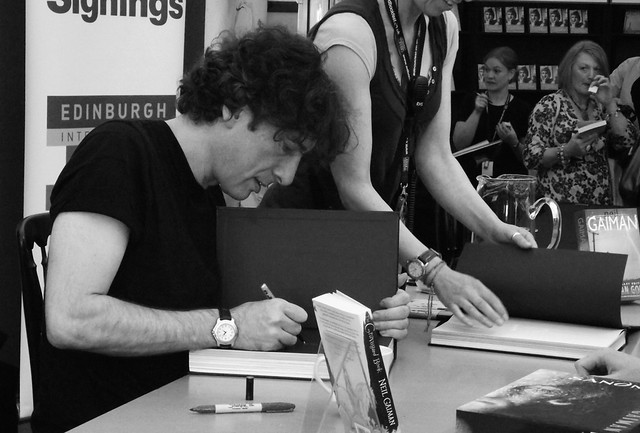
Edinburgh International Book Festival - Neil Gaiman 06
(Neil signing at the Edinburgh International Book Festival, pic from my Flickr)

Neil Gaiman has been one of my favourite authors for many years, and a jolly nice chap to boot. He has short stories, essays and interviews available on his site that you can read here, and you should check his Twitter for more material or links to fellow creators and their work that he often shares. For younger readers you can find video of Neil and others reading from the wonderful Coraline and The Graveyard Book on Mouse Circus here.

S h o r e l i n e   O f   I n f i n i t y

Shoreline of Infinity is an excellent journal of science fiction produced here in Edinburgh (disclaimer, I write book reviews for Shoreline), home to to short fiction, poetry, articles, reviews and more (with an associated regular happening, Event Horizon, that takes place in Edinburgh with readings, music and more). In the spirit of helping out during self-isolation and Lockdown, you can get a taster of the first eleven issues free until April 4th.

A d r i a n   T c h a i k o v s k y 

Cymera 2019 - Gareth Powell, Ken MacLeod, Adrian Tchaikovsky02
(Adrian Tchaokovsky, on the far right, with Gareth Powell and Ken MacLeod after our Cymera Festival event in 2019)

I’ve seriously enjoyed Adrian’s Children of Time and Children of Ruin in the last couple of years – clever, immersive, millennia-spanning science fiction with an evolutionary slant – and was lucky enough to chair a talk with him, Ken MacLeod and Gareth Powell at the first Cymera Festival last year. Adrian has put up Short Changes, a collection of short stories (including one with Keris McDonald, which you can get hold of free here.

A l i e t t e   d e   B o d a r d

I love Aliette’s work – she crafts some amazing worlds that are outwith the regular, Anglophone Western science fiction and fantasy tradition, different, enticing. She has a short story, In the Lands of the Spill, on Avatars Inc (artwork by Priscilla Kim)

COMICS

L e e   R o b s o n

Lee Robson, along with collaborators Alfie Gallagher, Jim Lavery and Lord Brignos, has put up some of their comics work from Zarjaz and FutureQuake. As many of you will know, those are some top UK Indy small press comics works, with a heavy 2000 AD tilt (in fact the guys at 2000 AD like them and some of the official writers and artists have been known to do the odd strip for the fanzines!). They have a collection of works available to download free here.

2 0 0 0   A D

The droids at the Galaxy’s Greatest Comics are making Thrill Power available free during the lockdown – you need to register or use the 2000 AD App, but the material is free, including an entire 400-page Judge Dredd: the Complete Case Files Volume 5 (which includes the legendary Block Mania and Apocalypse War tales), with work by John Wagner, Alan Grant, Brian Bolland, Mick McMahon, Carlos Ezquerra, Steve Dillon and more.

J o e   L a t h a m

Joe Latham has generously put three of his Indy comics up on Gumroad – A Seed Named Hope, Digby is a Wizard and Losing Sleep – to download for free here.

B r y a n   T a l b o t

Bryan is, for my money, one of the foremost masters of comics in the UK, award-winning writer, artist and damned fine chap to boot. James Robertson, who maintains Bryan’s official site (great place to see a lot of his work, previews of upcoming work and more), has worked with Bryan to make a bundle of Bryan’s comics work available online, covering a huge swathe of Bryan’s long career, with CBR versions here and PDF versions available here.

M a r v e l

Mighty Marvel Comics has made a bunch of comics works available free online via their Marvel Unlimited App, and nice to see they are encouraging readers to buy issues from local Indy comics shops once it is safe again too.

Quiet Streets

I took a long walk on a nice day off at the end of the week, avoiding my usual refreshment stops in a pub on the way (this was before they were closed, but I had already decided not to risk going into any for a while). Gorgeous spring light that day, but only a handful of people out, even before the Lockdown. This was rush hour on Lothian Road, normally nose to tail traffic at five in the evening and busy busy stops, but here you can see just a few people, sensibly spacing themselves out to keep “social distance”:

Bus Stop 02

Next to the bus stop is the Usher Hall, the Lyceum Theatre and Traverse Theatre, and these illuminated displays normally extoll the upcoming concerts and shows, but with the theatres and nearby cinems already closed by this point, there are now shows, and the posters for them have all been taken down, all very sad (for my own part theEdinburgh International Film Festival which I always attend and the second Cymera literary science fiction festival I take part in during June are also now cancelled.)

All Shows Are Cancelled

Eleven at night on Lothian Road – with several cinemas, theatres and many bars and restaurants this area is usually extremely busy on a Saturday night, but here it was quite unsettlingly quiet, rather eerie, actually. Bars, theatres all closed, people were already staying at home even before the Lockdown was announced, I saw perhaps two people where normally this spot is so loud and busy with pub crowds that I’d avoid it on a Saturday evening:

Empty Streets 02

Empty Streets 04

One spot of life, a solitary shopper in a late night corner store:

Open Seven Days

Much needed restocks arriving at a local store:

Men At Work

Took a walk with chum and his hound on Sunday, lovely bright day, the streets again were unnaturally quiet, although away from the main roads the parks, walkways by the river and canal and so on were quite busy, people obviously thinking these were a bit safer to let them get out but still have some safe space between them.

Enjoying the Spring Sunshine While Keeping Our Distance

Passing over the Union Canal I saw this couple enjoying the spring sunshine by having a drink on the rear deck of their house barge:

House Barge

Leamington Lift Bridge

Meanwhile this chap was using the park to keep his space from other people but also practise his juggling skills!

Juggling in the Park 02

Reviews: Charlie’s Angels

Charlie’s Angels,
Directed by Elizabeth Banks,
Starring Kristen Stewart, Naomi Scott, Ella Balinska, Patrick Stewart, Djimon Hounsou, Elizabeth Banks

Elizabeth Banks writes, directs and stars in this latest take on the all-woman super-team that was such a popular staple of 1970s TV viewing. Originally touted as a reboot several years after the frantically bonkers fun of the McG Angels films with Lucy Liu, Cameron Diaz and Drew Barrymore, instead the decision was taken to make this a continuation of both the films and the original TV series. Not that this is a sequel – it is a new story and new Angels that you could take as stand-alone if you so wished, but it tips its hat with some montages and cameos to the TV series and the films, to include them in this history. This is, effectively, a new entry in those stories, set years on with the latest recruits, but, rather satisfyingly, I thought, including that previous history as a background (even including original 1970s Angel Jaclyn Smith in a cameo as one of the senior staff who train the new girls).

Since the events of the previous films the Townsend Agency has gone international, in an expansion lead by the main Bosley (now a rank in the organisation), John Bosley, played by Patrick Stewart (who looks as if he was having a lot of fun here), with other Bosleys in charge in offices in different cities and countries, and a larger roster of highly-trained Angels on call for missions around the globe (although here this is mostly background, with the story, wisely, sticking mostly to the tried and tested tradition of the triumvirate of three women agents and a Bosley to help). We open with a mission to bring in a creepy international fraudster, the sort of man who happily steals from disaster relief funds, brought down by his misogynistic take on women (Kristen Stewart’s Sabina using this weakness to infiltrate then take him down with help from the other Angels, including Ella Balinska’s impressive Jane Kano, a former MI6 operative). This success crowns John Bosley’s final act at the Townsend Agency as he is preparing to retire.

The main story follows Sabina and Jane in Europe, following up on Elena Houghlin (Naomi Scott), a programmer at a hi-tech firm with a radical (and badly needed) new power device for the world, which she has found has a serious problem – it can be hacked to be used as a deadly weapon rather than purely for good as an environmentally-friendly form of energy. Her attempts to tell the head of the company, Alexander Brock (Sam Claflin) about this and how she can fix it are thwarted by an oily supervisor, Fleming (Nat Faxon), and a cold and relentless assassin, Hodak (Jonathan Tucker), which is, of course, where our heroines step in.

I’m not going to risk any spoilers by going too far into the plot, which, anyway, is, as you’d probably expect from this kind of movie, delighting in twisting around with surprises and double-crosses and red-herrings as to who really is pulling the strings here, and why, and just how this involves the Townsend Agency in ways they never expected. Suffice to say it rolls along at a cracking pace, and while the style is different from the McG films (which had a very stylised look and cut), there is a similar mix of action and humour and some bonding between these very different but equally strong and determined women.

We get high-kicks, car chases, abseiling off tall buildings, clever gadgets (mostly non-lethal, these are the Angels, after all, they prefer not to just shoot people) and globe-trotting locations and stylish outfits. In other words we get pretty much what we want from this sort of film: it’s a great, fun ride of action and humour, with Stewart and Balinska particularly strong as two very different personalities that still manage to be complimentary despite those differences, and there is always that great underlying message that Angels, new and old, are unstoppable when they work together. A perfect Saturday night popcorn movie to enjoy.

Charlie’s Angels is released by Sony Pictures Home Entertainment on digital on from March 23rd, and on Blu-Ray and DVD from April 6th

This review was originally penned for Live For Films

Reviews: the Wolf of Baghdad

The Wolf of Baghdad,
Carol Isaacs (aka The Surreal McCoy),
Myriad Editions

The Wolf of Baghdad opens a world away, with an aerial shot of London, our opening perspective a view over the Thames with many globally famous landmarks visible, from the old like Tower Bridge to the new, like the towering Shard. Over this splash page musical notes float languorously in little bubbles of their own. We follow this warm stream of music floating through the London air, across the cityscape, from the dome of Saint Paul’s to regular, the open space of parkland, then urban residential streets, until we find the source, in a woman’s living room. She is sitting alone, listening to the music coming forth from her stereo, lost in thoughts and reveries, the music sparking images of other times, other places, other people, now long gone, vanished into history.

Or no, not vanished. They live now in her memories, in the stories passed down through her family and their friends, in the music of those days, and in the box of photographs she is reaching for on top of her bookcase. She falls asleep on the sofa, photos strewn over her body. She wakes with a start, there is someone sitting in the armchair next to her. An old lady knitting. Except she’s not really there, she’s a projection, a ghost, summoned from her memories roused by the songs and the family photographs. Isaacs beautifully captures in a couple of small, brief panels, the emotion on her face, from shock at finding someone else in her home to the sheer delight at recognising a beloved family member to the disappointment that no, she isn’t really there, this is a dream, an echo.

I think many of us who have endured loss will feel the emotions of that seemingly simple scene deeply – how many of us have dreamed we’re walking with a long-gone loved one, woken smiling only to remember they’re gone and it was just a dream, that this is the only place they now live for us. Isaacs weaves this irresistible mixture of longing, of the happy warmth of memories, and the disappointment of the reality, the contrasting emotions contrasting and yet also in that peculiar way life manages, complimentary to each other.

Isaacs rises from her chair, leaving her spectral visitor behind, donning her grandmother’s old cape she would always wear outside the home, stepping through her front door, but not into her own apartment block, but the old family home in early 1900s Baghdad. She walks through the kitchen, the heart of any household, and ghostly, translucent images of the people who lived there – her people, her family – move around her, oblivious. It seemed to me that they were not the ghosts, but actually Isaacs herself was now the invisible phantom, a ghost from the future walking unseen through her own family past.

These scenes are lovely, warm, inviting – the family house, like many in the Middle East, built around an open courtyard so the family could sit outdoors in the heat but still be within the home. She passes her Rabbi grandfather’s study – a sudden splash of inviting, warm yellow colour spills out of the mostly blue palette of these pages, the lamp-light he is contentedly reading by, and on to the roof, which like many buildings in the region is flat, so that on hot nights the entire family, from baby in the crib to grandmother could sleep outside, under the starlight. This also affords Isaacs the perfect excuse to delight the reader with the glories of sunrise over the domes and minarets of early 1900s Baghdad, seen from the roof of the family house.

The view of the waking city entices Isaacs to venture outside into the bustling city streets, where Muslims and Jews and Christians all mingle. There are beautiful little details – a street urchin sneaking food from a street stall, a small child tugging on his mother’s hand when he sees a vendor selling sweet treats, the old men playing their games in the cafe, the bustle and life of the soukh,. The many other little details that bring it to life and make it so wonderfully personal and intimate – the children learning to swim in the Tigris (imagine your swimming pool being this great world river that has flowed past thousands of years of human civilisations growing around its banks), or being carried over the regularly overflowing small alleyways to get to school.

Despite Jewish people having lived in Baghdad since they were first captured and taken to ancient Babylon – a history of over two and a half millennia – sadly this will not last, and the latter part of the book sees our spectral narrator walking through the shadows of growing threats, shadows which soon grow into full-formed nightmares of hatred, killing, pogroms, as a rising Arab nationalism is fuelled in the 1930s and 40s by imported anti-Semitic rhetoric from distant Nazi Germany. It’s heartbreaking and sadly a story which has, in one form or another, happened far too often throughout human history.

We see the burnings and the beatings and the disappearances into dark jails. Again Isaacs conjures panels that pull forth the emotion of those moments, such as a scene showing her walking through the ransacked mess of what had been the family home, picking up a shattered photo frame, the people now all just silhouettes, or finding a torn Torah in the Synagogue.

From being almost a third of the population, through the 1940s and 50s and on most Jews were forced to flee forever, that history that had lasted millennia gone – today there are, perhaps, around half a dozen left in that ancient city.

Isaacs includes a lovely Afterword, which originally appeared in the Strumpet (which I am sure some of you will remember fondly), detailing some of her own memories this time, of family life when she was a wee girl, the family now settled in Britain. The regular suburbia is broken each month when visitors come from the old country to visit, bringing gifts and stories, her house-proud mother budding the family silver to a shine and creating a mountain of delicious food, the family friends so well-known they children would always refer to them as aunt or uncle – all small details which most of us probably also share from our childhood. And the hints of the past these visitors brought with them to suburban Britain, of the home now lost to them which they can never return to, but which haunts their dreams.

And the eponymous wolf of the title? An old Jewish tradition in Baghdad was that the wolf would protect the household, watch over the family, that any malicious Djinn would be too scared of the powerful wolf to dare to enter the house or harm those within. A wolf’s tooth would often be set in a small jewel to hang over the baby’s crib as a protection. Sadly, as Bardach observed many years ago, “man is wolf to man”, and despite appearances the man-wolf has a far more terrible bite than any canis lupus, even a mythical one unable to protect the family from the storm that befell the Jews of Baghdad. (or, perhaps the wolf did watch over them, seeing them to their new home, perhaps his glowing eyes still look after them as best he can in a strange land).

This is a remarkable book and, despite the horrors of the later section, ultimately it is a beautifully-crafted, warmly emotional work. While it sheds light on a period and events most of us, even those of us who read a lot of history, will not be familiar with (always good to learn), mostly, I felt, this was ultimately a very personal, very intimate story, and the warmth of memories, of family, of love and hearth and home outweigh even the darker moments, with Isaacs’s artwork deftly expressing and conveying much emotional richness.

Reviews: First Love

First Love,
Directed by Takashi Miike,
Starring Masataka Kubota, Nao Ohmori, Shōta Sometani, Becky, Sakurako Konishi

The superb and prolific Takashi Miike returns to our screens on Valentine’s Day, and that is, of course, a good thing for those of us who love film. In First Love Miike returns to the Yakuza gangster genre that he has done so well before, but, naturally being who he is, he gleefully plays with the expected elements of the genre too, while still delivering a strong narrative with a sense of fun. And, as the title intimates, there is some romance going on between the drug deals gone wrong, the inter-gang warfare, the bullets, the sword-based beheadings, the corrupt police and conniving gang lieutenants. Oh, and the ghost of a middle-aged man in his underpants.

While there’s a good array of cast members, the main focus here is on two innocents, Leo (Kubota) and Monica (Konishi), who become accidentally embroiled in inter-gang warfare between the traditional Yakuza of Japan (now somewhat in decline) and the opportunistic Chinese Triads moving into their turf. Leo is a failing boxer, skilled but somehow not quite getting his act in the ring together as he should,, and now living with recently revealed news that he has a terminal brain tumour. Monica (Konishi – Miike specifically wanted a newcomer for this role) is a troubled young woman, effectively sold by her father into sex work and living next to one of the Yakuza members and his rather nasty girlfriend with anger management issues. And poor Monica is also troubled by the spectre of her father appearing to her, clad only in his white underpants; a symptom of trauma brought on by abuse or just hallucinations brought on by drug use? Or both?

As the Yakuza and Triads fight one another over a bungled drug deal, and plotting gang members attempt double or more crosses to further their own personal gains, Monica is pursued, suspected of having a missing drug shipment. When she runs from a corrupt police detective who is involved with the Yakuza after being spooked by another ghostly vision (which no-one else can see), Leo rather gallantly floors the pursuing officer. Unfortunately he had no idea it was a policeman he had just knocked out, he thought he was protecting a young woman from a predatory older man.

The pursuit of these two young people, caught between competing Yakuza and Triads, is the main engine of the story here, but a simple description of the plot like that doesn’t do First Love justice. It is, after all, a film by Miike, so you will be unsurprised to hear me tell you that is is replete with some delicious, delectable moments of sly, often gallows-black humour (a fast editing cut from a falling boxer to a gangster’s head rolling across an alley after being decapitated by a katana blade, a conspiratorial gangster who ends up with an accidental dose of the missing drugs sparking both a sexual faux-pas and a hilarious inability to feel pain during a fight scene), while Miike, as always, takes generic elements and puts his own very stylish stamp on them to great effect, and yes, there is a romance here, but again it takes its own peculiar form.

Action, romance, humour, bullets, swords, drug deals gone bad, gang warfare and ghosts in underpants, First Love is an absolute pleasure.

This review was first penned for Live For Films.

First Love is released by Signature in UK cinemas and Digital HD from Februry 14th, and on DVD and Blu-Ray from February 24th.

William Gibson returns with Agency

Agency,
William Gibson,
Viking Penguin,
Hardback, 416 pages, £18.99
Published January 2020

Bill Gibson, arguably one of the most influential SF writers of the last few decades, returned to full-on science fiction with The Peripheral several years back (reviewed here). Agency follows on from that book, but there has been a pretty substantial, five year gap between the two, much of this caused by the pesky Real World interfering in the plot. Agency is not so much a direct sequel to Peripheral as a story set in the same world established in the preceding novel, with some characters carrying over and new ones taking the lead. It retains the idea from the Peripheral of a century or so hence future where our world has been radically changed after the “Jackpot”, a series of events (environmental, war, disease, political, economic) which decimated the global population and left the descendants of the super-rich oligarchies (the “klepts”) in charge, democracy a distant memory, the world barely stabilised by the use of cutting edge tech.

And again it involves the “stubs” – these rich oligarchs have discovered a mysterious server which allows them to connect digitally to what seems like their past. They can’t go there physically – there is no actual time travel as such here in the traditional sense (although sometimes they can go visit via telepresence in a remote controlled artificial body) – but can exchange information, allowing them to interfere in those eras, some for entertainment (often for malign kicks), as if they were playing a Civilisation style video game, except these are real people’s lives that they are playing with, (not hard to see the real-world commentary here!). This has no effect on their own timeline’s history as the moment they make contact with any such past it branches off into a parallel timeline, the so-called “stub”.

The formidable police inspector Lowbeer is tasked with ensuring that none of these klepts acts in too outrageous a way, that could threaten the precarious stability of their society (a society run by corrupt oligarchs not exactly being too stable to begin with). A new stub has come to her attention, one where Trump lost the Presidential election and Brexit never happened – and this is where the long delay between the two books comes in. Poor Bill was taken by surprise by the results of both of those votes, as many were, and realised some of what his characters would be doing made no sense in a world in which Trump and Brexit existed, causing a long delay and much re-writing and new thinking.

However, if you didn’t know this I doubt you would pick up on it from the writing – Gibson is far too professional for that. He’s always had a knack for smooth descriptions and highly-crafted prose style, and I think that is a skill which has just become better over the years. Here it has resulted in him taking the world-building from The Peripheral but delivering a related but very different story. Despite avoiding some of our timeline’s mistakes the new stub is still facing similar dangers the main timeline did (the looming Jackpot disasters), not to mention a looming threat of war around Syria and Turkey that could spiral into nuclear Armageddon very easily.

In this stub, unlike the main timeline, what may be a true AI agent – Eunice – has emerged from a murky mixture of covert military tech and Silicon Valley development, and some are panicking about what they may have unleashed when testing her. Verity, an influencer and “app whisperer” has been given Eunice to test by a tech start-up, unaware of the vast conspiracy that comes with this until she is dropped into it, while Eunice is going to have to develop very quickly if she has any chance to survive and grow, let alone maybe, just maybe, be able to help the human characters steer her timeline from its destructive course. Lowbeer feels some responsibility to help this timeline, and Eunice, and recruits Wilf (last seen in the Peripheral) to aid in whatever way they can to protect this stub from disaster (both from her own interfering timeline and from the potential disasters of its own timeline).

The best science fiction has always, at its core, addressed the problems of the modern world and society, no matter how disguised by futuristic settings and tech, and of course Gibson is no stranger this; it is something he has done in most of his books from Neuromancer onwards. Agency continues this, very satisfyingly hitting a number of hot-topic buttons, from the One Percent and their unprecedented level of control and influence in larger society, environmental collapse, the role of tech in our society (for good and ill), potential global flashpoints like Syria Turkey and Russia that could easily spiral into something worldwide, the dangers of undermining democratic institutions, of taking moral responsibility for our actions.

Couple this with a tense narrative, delivered in short, punchy, often fast-pace chapters, and characters you can’t help but care about (I think I fell in love a little bit with Eunice and Verity in particular, and the odd relationship developing between the pair) and you are in for a terrific, involving read from a great author at the top of his game. Well worth the wait.

This review was originally penned for Shoreline of Infinity, Scotland’s leading journal of science fiction, featuring short stories, poetry, articles, reviews and more.