Rainy Evening

That I like night shots of the city is no secret – since I was a kid playing with the “B” setting on my first 35mm film camera (a compact Ricoh with manual controls, so I could learn before moving onto an SLR), I have been fascinated with the way the camera can see the nocturnal world in a way that our eyes cannot, through a long exposure (sometimes just half a second, an eternity for a camera lens, sometimes several seconds, sometimes a minute to really drink in every bit of light in a very dark area).

Haymarket On A Rainy Evening 067jpg

But there is something even more compelling about nocturnal, urban shots on a rainy evening – the way the traffic lights, street lights, headlamps of vehicles, all glisten and reflect on the wet roads and pavements, creating a very distinct and atmospheric look.

Haymarket On A Rainy Evening 06

Haymarket On A Rainy Evening 05

I was returning from visiting dad, and so not carrying my tripod, or even Professor Bendylegs, my mini-tripod with the, yes, bendy legs. But as I exited Haymarket Station at the tail-end of Blue Hour on a rainy autumn evening, the scene was too good not to try and capture. So I did what I often do and improvised my long exposure shots, setting the mode and timer on the camera, then sitting it on handy posts or railings with flat tops, to steady it enough for a long exposure.

It doesn’t always work, but often does – obviously unlike a tripod you are very restricted in your choice of angles. You can sit the camera flat on this surface to steady it, but you can’t do up or down or angle it sideways. But within those restrictions you can still sometimes improvise something interesting, capture a moment of the city’s life.

Haymarket On A Rainy Evening 04

Haymarket On A Rainy Evening 03

Another thing which has fascinated me since I was a kid first messing around with camera settings, is that the long exposure not only drinks in more light than your eye, to show details it is too dark for human vision to make out clearly, it also has a fascinating effect on moving subjects. People in the background are blurred by movement, but still fairly recognisable, but those closer to the camera become transparent, like phantoms, ghosts walking the night, caught by the artificial eye. Passing vehicles are stretched out (like the “warp speed visual effect in Star Trek), or else vanish altogether, but long “light trails” from them remain, showing their track, while the vehicle itself often vanishes.

Haymarket On A Rainy Evening 02

Haymarket On A Rainy Evening 01

This one was much rougher, as it was handheld – there was nothing nearby I could sit the camera on to steady it and fit in the illuminated entrance to the original part of the rail station, so freehand it was. I took several shots, in black and white mode, this one, still rather rough, was the only one that was passable. But it had that kind of Noir look to it that I liked, and sometimes a little roughness suits that kind of subject matter. I must have done something right, because this one pic got over a thousand views and fifty favourites in the first 24 hours of posting it on my Flickr photo site (now over 1200 views and 61 faves, not bad for a spur-of-the moment shot taken walking home on a went night).

Haymarket Noir

A Visit From Sir Nigel

Dad came through for a visit, so we could go together to watch the beautiful steam locomotive Sir Nigel Gresley paying a visit to Edinburgh’s huge Waverley Railway Station

Sir Nigel 03

Sir Nigel 02

Built in the 1930s, this is an A4 Pacific mainline locomotive, very powerful and fast (its sister loco, Mallard set the world speed record way back in the 1930s, hitting 126 MPH – obviously modern high-speed trains go far faster now, but it still retains the record for the fastest steam engine). They also boast this magnificent “streamliner” casings, partly about aerodynamics, partly drawing on the Art Deco style of the period. Like a few other transport designs, such as the Jaguar E-Type, I think it is a design which manages to be very much of its era and yet somehow also quite timeless.

Sir Nigel 04

Sir Nigel 05

Sir Nigel 06

Cabin crew leaning out to talk to the crowd on the platform

Sir Nigel 09

Sir Nigel 014

A perspective shot, to give an idea of the sheer size of this steel beast

Sir Nigel 011

Sir Nigel 012

Sir Nigel 013

Sir Nigel 015

Steaming Into Town

The other weekend I got to see a gorgeous-looking steam locomotive, Tangmere, steaming its way into Edinburgh’s huge Waverley Station, after hauling a line of coaches up from York that morning.

Tangmere 02

Tangmere 03

Tangmere 04

It’s quite something to see a mainline steam locomotive in this day and age – I could hear it before I saw it, that distinctive huff-huff-huff sound before it emerged from the tunnel in a cloud of steam. It’s very different from seeing on in a museum, as a static exhibit – this is one doing what it was built to do, snorting steam, “breathing”, fire in its belly, a steel dragon, effortlessly hauling a long, line of coaches.

Tangmere 08

Tangmere 09

Tangmere 010

Tangmere 011

I’ve never seen one of this type in action before – Tangmere is a Battle of Britain Class loco, named after the RAF airfield near the village of Tangmere, which was an important air station during the Battle of Britain. These “spam cans” or “slabsides” (due to their distinctively shaped airflow casings) were designed for the Southern Region, so not something that would be seen up here even back when steam locos were common.

Tangmere 012

Tangmere 013

Tangmere 015

Tangmere 016

One of the massive drive wheels in close-up

Tangmere 017

Tangmere 018

Vid - Tangmere

The Clyde Coast

Wemyss Bay Station 018

Dad and I went off down the Clyde coast over the holiday weekend, with glorious spring sunshine sparkling on the Firth of Clyde as we drove alongside. We visited the beautiful old station at Wemyss Bay, often counted as one of the ten most beautiful railway station in the British Isles. The old steel and glass canopy let the light flood into the station:

Wemyss Bay Station 01

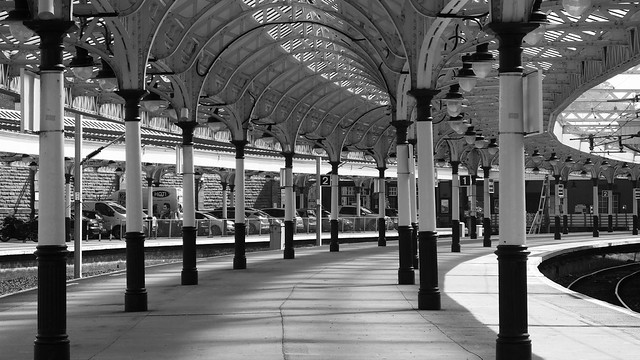
The canopies above the platforms have a gentle curve to them, which coupled with perspective and the natural light coming in makes them a popular subject for many Scottish photographers:

Wemyss Bay Station 09

Wemyss Bay Station 014

The station was built to connect a railway spur to the Glasgow line to the coast and the steam ships plying the waters of the Firth of Forth, and the station still has a working dock for ferries to the islands, with this handsome wooden and glass sloping (and again slightly curved) walkway to take pedestrians from the station down to the berthed ferries:

Wemyss Bay Station 06

And talking of which, here’s one of the ferries, the Bute, coming into dock:

Wemyss Bay Station 019

Wemyss Bay Station 022

Wemyss Bay Station 024

Wemyss Bay Station 025

And on the way back up the coast we passed the beautiful Cloch Point Lighthouse, built in 1797 by Thomas Smith and his son in law Robert Stevenson, part of that great generational family of engineers, the Lighthouse Stevensons, whose line would also one day produce one of Scotland’s greatest writers, Robert Louis Stevenson, and whose remarkable feats of engineering still mark our coastline today and still protect mariners.

Cloch Point Lighthouse 01

Cloch Point Lighthouse 04

Cloch Point Lighthouse 05

“They shall not grow old…”

For Armistice Day, one of Edinburgh’s smaller memorials, a little plaque in Edinburgh’s Waverley Stations, probably passed by and largely ignored by thousands of people every day as they go around their busy journeys, a tiny reminder of the past, of maimed and injured soldiers coming home from the War to End All Wars, resting here on their way, hopefully cadging a brew-up and a fag from some Red Cross volunteers. A little corner of history, if you care to look for the echoes of the past that still sound in the present.

Great War memorial, Waverley Station

“As they at last comprehend all their sacrifice, all their pain,
All their sorrow, all their suffering, all the death,
Did not change or alter a thing, was not a lesson learned
Nor an experience not to be repeated..
Realizing their friend’s painful, brutal, ultimate sacrifice
Was only a necessary evil of Mankind’s political process
Which has never changed, and never will,
For each generation brings anew to the world
Its own self-styled madness of universal death, tragedy and suffering,
In wars to be fought by the young, bright-eyed children of the world
Unknowingly raised as sacrificial lambs of slaughter,
To be killed and gone forever, for nothing.
That is why, all Veterans cry.

In this hallowed place of the dead
The lonely graves of war’s youthful victims
Who died for a thought,
an idea, for a cause
Promulgated by selfish, insane men in power
These war graves and cemeteries are Harbingers
Of the eternal, mindless death cycle of war.
Young men killed by politicians’ words and mindless acts,
Their promise and existence forever ended too soon.
Now, forever sleep beneath the green muffled grass
Sharing the earth with the youth and victims of past wars,
Too numerous to count, to numbing to contemplate,
The dead, as powerless and impotent as the now living
To change or alter, or detour the inexorable course of madmen,
They patiently wait for the next generation to join them
.”

a fragment from Harbingers, a poem on the occassion of the Normandy landings anniversary by Curtis D. Bennett