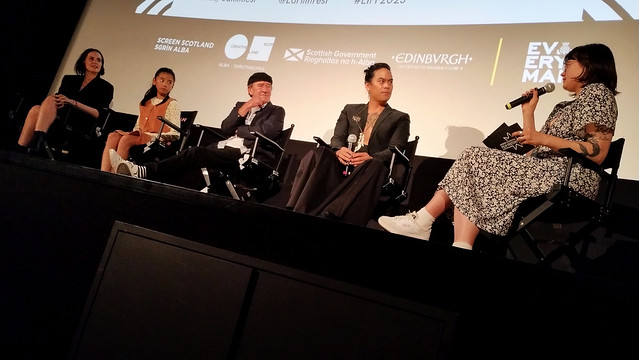
Edinburgh International Film Festival 2024 – The Substance

Edinburgh International Film Festival 2024 – The Substance
Directed by Coralie Fargeat,
Starring Demi Moore, Margaret Qualley, Dennis Quaid

This was another of the revived Midnight Madness strand of late night flicks a the Edinburgh Film Festival this August, arriving with quite a reputation ahead of it, partly from the reputation director Coralie Fargeat garnered with her previous film (Revenge) and the win at Cannes (The Substance won Best Screenplay), partly from having such a major Hollywood star as Demi Moore tackling this kind of film. And yes, it is a doozy! Loud and very much not subtle about some of the points it is hammering in, and yes, Fargeat’s love for the likes of Carpenter and Cronenberg is very, very much on show here.

The premise is fairly simple at first, and deals with a subject that is all-too-real (in contrast with the film’s more fantastical elements): the way the media, especially in Tinsel Town, chews up talent, especially women, creating stars, but only as long as they remain beautiful, young – perfect. When that idealised version on the screen can’t quite be achieved anymore (wrinkles, grey hairs, how dare a star – especially a female star – dare to grow old, grow imperfect). Elisabeth Sparkle (Demi Moore) has been at the top of her game for years, her morning workout show a huge hit. But now she’s getting older, and this is a kind of show that doesn’t really sell exercise and healthy living, it sells a sanitised, idealised, and unattainable version of perfection. They don’t call it the Dream Factory for nothing…

Let go from her previously huge show, Elisabeth is furious, and her treatment by Harvey (Dennis Quaid), the incredibly sleazy, amoral boss just increases the sting. On a downward spiral, she gets involved in an accident, and it is at the ER for treatment that an incredibly handsome young doctor tells her she is a “good candidate”, slipping something into her pocket. This turns out to be a USB drive with a phone number and a hand-written note saying “it changed my life”. When she finally feels driven to try this, she has to follow mysterious instructions which take her to an unusual location, where a package is waiting for her, and the promise of a better, more perfect version of her being attainable.

I don’t want to go too much further into the narrative here, because this is a film that is best experienced knowing only the bare bones of the desire that pushes this story. That’s how I went into it, knowing it was something to do with a big star hitting her 50s, finding she’s no longer seen as desirable, and that there was some mysterious method to recapture or recreate her more youthful glory (Moore herself said this was one of the reasons she agreed to the film, because she’s had first-hand experience of this very common, not to mention sexist and ageist, problem). But there were so many ways I could imagine that idea being developed – is it a serum? The kind with a price? Is is illegal cloning of some sort? Genetic manipulation? Magical elixir like Death Becomes Her? Go down the Portrait of Dorian Gray route?

Well, again, I’m not saying, except to note that it unfolded in a manner I really wasn’t expecting. A method that was visceral and disgusting and gruesome (oh, the things we do for youth and beauty and fame!), far more so than I had anticipated. In fact I’d say some scenes in The Substance are up there with the disturbing yet compelling body horror of earlier Cronenberg, or The Thing-era Carpenter.

This is not a subtle film – right from the start it really makes its points in a heavy manner, from the time-lapse of Sparkle’s star being created on the iconic Walk of Fame, photographed, admired, slowly forgotten as years pass, to those giant L.A. Billboards (including one right outside the window of Sparkle’s apartment), or flashing up the heavy, block lettering of the instructions on each stage of her package being thrown up massively on the screen, all to pounding, thumping music (the soundscape is as relentless as the visuals). It doesn’t just make a point, it hammers the viewer over the head with it, repeatedly, aurally and visually.

I’m really in two minds about that approach – one part of me really admires and enjoyed it, and loved Fargeat for such an all-out, no-holds-barred, fearless approach, while at the same time there were moments where I found myself too much, too often. Which is it, ultimately? Both, I think! Yes, sorry, that is a bit of a cop-out, but it really did leave me impressed and taken aback but at the same time feeling battered and bruised by its relentless, OTT approach too. Although set in the present (judging by the tech, like the phones), the visual flair and style really put me far more in mind of that pumped-up 1980s vibe (think Jane Fonda’s workout era), and as with the intense, almost breathless approach, I suspect that too was deliberate, being a decade remarkable for excess and that “be all you can be” ethos taken to the max, not to mention when Moore herself was first starting her rise to fame.

Moore and Qualley give their all, even when it comes to scenes involving a lot of practical effects and make-up (all credit to them, I mean they really go the distance and then some with this -you’ll see what I mean if you watch it!), while Quaid seems to be revelling in playing an absolute sleaze bag of a Hollywood suit, cocksure, leering at the female talent (as long as they are still young and perfect), seeing them just as something to use, consume, mould, discard and onto the Next Big Star when the first crow’s feet appear, disgusting in his habits, uncaring. Everything here isn’t just dialled up to 11, it goes far beyond.

As I said, it both wore me out with this relentless visual and aural assault, and at the same time it impressed the hell out of me, the way it took a real-world problem and blew it into all sorts of new shapes (often disgusting shapes!), with some incredible and frequently stomach-churning visuals and effects (and I say this as someone who loves The Thing and Society and the Cronenberg oeuvre). A remarkable, highly unusual, full-throttle, OTT but in the best way; horror that has to be experienced.

This review was originally penned for Live For Films

Edinburgh International Film Festival – Short Film Competition

I always find the live action and the animated short film section of the festival to be a fascinating one. The short work is often where you find new or different talent, starting to spread their wings, and that’s something any art form needs to encourage (I also find it heartening that that film festival has a number of these mostly-new film-makers present to talk about their works, which are often very personal). All of the works in this strand were in competition for The Thelma Schoonmaker Prize for Short Filmmaking Excellence, named for the acclaimed, Oscar and BATA winning editor, renown for her collaborations with Martin Scorsese. As with any collection of short works, it’s a varied mixture. Some will connect more with one viewer, others with a different viewer, but regardless of who wins, hopefully exposure at this sort of festival event helps boost the creator’s signal and get them noticed in the wider media sphere (and perhaps even help in opening other doors further down the line, always a constant struggle for any artist in any artform).

There was a pleasing diversity on offer here – one audience member who stood at the end of the Q&A with the creators summed it up nicely when he thanked them for making us cry and laugh. We moved from friends creating music and celebrating a birthday (Argentinian entry Shoal) to a special anniversary for an elderly couple, the wife in the grips of dementia, her erratic memories bursting forth in the form of animation created using napkins (Wilma Smith’s The Jubilee), to a monochrome homage to the golden age of silver screen monster movies in a world where werewolves are real (Manny Wolfe), to exploring family memories and exploding houses (Liberty Smith’s My Exploding House) , father and son relationships (My Dad and the Volcano by Scottish creator Gavin Reid, who, it turned out, once worked in the Cameo Cinema where the films were being shown, and Lisa Clarkson’s Paternal Advice, adapted from a story by noted Scots author Janice Galloway), mother and daughter relationships and living on the breadline (Jamie Di Spirito’s Homework), and gender identity (Max Olson’s Nico). It really was a satisfying and diverse selection, from home and abroad. There isn’t time or space to cover each entry – I thought they were all strong in their own ways, but I can’t cover everything, so here are just a few thoughts on some that particularly touched me:

Trevor Neuhof’s Manny Wolfe tickled me in all the right ways – as you may guess from the title, this was the werewolf short film. Lovingly shot in black and white, with that silvery sheen characteristic of those 1940s and 50s horror films, it is also poking gentle fun at Tinsel Town (Manny works as a waiter, but explains he is an actor – a director dining in his restaurant just nods wearily, you and every other waiter in this town, kid). In this world werewolves are real, but they are just people, not bloodthirsty monsters, and while the horror flicks may seem made for him, Manny keeps losing out at auditions because he wants to be a serious actor, not just a howling wolfman. It’s funny and touching, both to fans of classic horror, and also to the struggle everyone who has worked in Hollywood has gone through to make it, that anyone who loves the film medium will be aware of.

Manny Wolfe Teaser from Trevor Neuhoff on Vimeo.

Max Olson’s Nico was a beautifully crafted piece, following a young trans man (Rene Leech); we see them shaving off their longer hair to a buzz cut, breasts bound, a gentleman’s overcoat, but the disappointment on their face when a nightclub doorman refers to them as a woman, and realising that these changes haven’t altered the way many others see them. The actor plays this with such vulnerability and quietness, head always down, not making eye contact, usually on their own in a dark city, alone even in the crowd of the dance floor of the club.

There’s such a fragile beauty to it and vulnerability of someone trying to be who they want to be that you almost want to hug them and tell them if will be alright. The elderly widow in the next apartment sees them in the man’s coat and tells them they look like her late husband, leading to an incredibly touching shared moment between two souls struggling with where life has taken them; ultimately this beautiful short film is about the fact each of us has our own pains and needs, and it is only those precious connections to one another than can really anchor us.

Wilma Smith’s The Jubilee was a mix of live-action and animation, most of the latter created, hand-drawn on table napkins and tissues (the objects themselves, rather cleverly, can become animated too, moving, rolling up to evoke emotions of loss, grief, anger and fear). On those napkins we see a woman, then a dashing man in a suit, who she at first thinks is her father, before realising it is her beloved husband. A cacophony of voices can be heard in the background, commenting about her condition, about her not having one of her good days, and to any of us (far too damned many of us) who have had loved ones slowly consumed by it, we will recognise this quickly as someone with dementia.

The Jubilee (2024) Trailer from Wilma Smith – Film Director on Vimeo.

Smith uses this simple animation medium (all done in her garden shed, cold in winter, roasting in summer) to great emotional effect; the feelings of disorientation, of knowing something is wrong, something is missing, but not knowing what or why, and the panic it brings, then the sudden bursts of memories that do remain, suddenly vivid for a brief spell. The final moments are live action, a family gathering for a special wedding anniversary, the live footage the real world we see, the animation the interior life of a mind and memory failing itself and trying to find the thread through an impossible labyrinth.

I think the thing that struck me with all of the works here isn’t just how well-crafted they were, it is also how wonderfully personal they clearly are to the filmmakers. Yes, of course, you can have a lot of personal elements in a feature film as a writer, director, actor, but I think perhaps with the short form it is more concentrated, you can feel the emotion in it, and that always enriches your viewing experience. From the short Q&A with the creators after the screening in the Cameo Cinema, it seemed even clearer that each of them had indeed brought a project that was very dear to them emotionally, and for my money that’s a good thing – any artistic endeavour that doesn’t elicit an empathic or sympathetic emotional response isn’t working for me, and these all touched me in different ways.

This review was originally penned for Live For Films

Edinburgh International Film Festival – Mongrel

Edinburgh International Film Festival 2024 – Mongrel
Directed by Wei Liang Chiang and You Qiao Yin,
Starring Atchara Suwan, Hong Yu-hong, Kuo Shu-wei, Lu Yi-ching, Wanlop Rungkumjad

This Taiwanese film arrives at the Edinburgh festival hot from the prestigious Director’s Fortnight at Cannes. Mongrel explores a subject which may be set in Taiwan, but sadly covers a subject which is all too common all around the globe: the trafficking and exploitation of undocumented migrant workers. In this case the gangmasters are in the mountain areas of the country, and using their workers (more like serfs) as care-givers for families who need them, but perhaps can’t afford the official care services, so this black market operation steps in to fill a need (for a price).

As we first meet the group, they are angry at their boss, justifiably so, because they have been working hard for him for two months and seen not a single penny of the money they desperately need to earn to send back home to their families abroad. When not working illegally (and mostly unpaid) they are kept in a secure compound, the euphemistically titled “dormitory”. Being undocumented workers, they have nobody to appeal to for help – employment or safety legislation simply doesn’t cover them, and regardless, even if it did, they dare not go to anyone in authority, because they would be arrested and deported.

It’s a wretched, desperate situation of exploitation, and yet Oom (Wanlop Rungkumjad), although obviously not happy at his situation, retains his sense of compassion – he gets to know the people he has to take care of, especially and older lady and her seriously disabled son. He’s not just going through the motions, he does actually care, despite being forced into this servitude, he’s a good soul and does his best by them, while also trying to mediate between his fellow workers and the boss (who as we see is in turn under a higher boss in the gangs, all running people’s lives like a business).

The film itself is very unusual – there’s not a huge amount of dialogue, particularly not from leading man Oom. Oom keeps most of his thoughts and feelings within, only small changes in expression and body language giving us a clue to what he is feeling; it is telling, perhaps, that the most I heard him speak was to the body of a deceased member of his group. The style too is unusual – some scenes go on for what feels like far too long (right from the start – the first scene is Oom having to clean mess from a bed-ridden client, and the camera stays fixed on the scene for quite some time), until it starts to feel very uncomfortable. The shots are often very static, not moving with the characters but the camera remaining in place as a scene acts out around it, or at other times leaves a character looking directly into the lens, normally a no-no for most film-makers.

And yes, this does create quite a strange feeling – as I said it is uncomfortable, but the more I watched, the more I thought that was exactly the idea, because we should be uncomfortable at these scenes, while the often static choices of camera work make us feel like we are watching someone’s life, more like a documentary than a fictional tale, but where we have a fixed viewpoint that we cannot look away from. Having characters occasionally look directly at the lens reinforces this, especially one scene where the disabled man seems to be looking right at the viewers.

This really will not be for everyone – it is slow, it does not build up the traditional narrative (backstory, main story, character arcs), and deliberately uses camera techniques that also give the viewer a strange and not always pleasant feeling. And yet, if you stick with it, this is a slowly effective and powerful way of highlighting this modern story of international exploitation, more effectively than a more heavy handed drama might.

This review was originally penned for Live For Films

Edinburgh International Film Festival – Oddity

Edinburgh International Film Festival 2024 – Oddity,
Directed by Damian McCarthy,
Starring Carolyn Bracken, Gwilym Lee, Tadhg Murphy, Steve Wall, Jonathan French

My first screening of this year’s 77th Edinburgh International Film Festival, and it was a welcome return to the very late night strand, which we used to enjoy in previous, pre-Covid years at the Filmhouse, when films which suit that late-night atmosphere (usually horrors) would be screened. This year, the Filmhouse still being closed (but with the fundraiser successful, currently renovating for its return, hurrah!), the equally wonderful old Art-Deco Cameo Cinema, long a part of the film fest, welcomed us into its comfy seats. The show may not have been starting until midnight, but the place was bustling, the crowd in excited, enthusiastic mood despite the lateness of the hour, and the excitement mounted as we had some of the cast and crew present for a brief talk before the showing.

Dani (Carolyn Bracken) is alone in an old, rural set of buildings she and her husband are slowly renovating, well outside of the city. Ted Timmis (Gwilym Lee) is a doctor at the local psychiatric hospital, and forced to work nights, meaning his wife is entirely alone in her isolated, large house. Dani is delighted to find that despite the remoteness, she has managed to find one spot, upstairs, in a far corner, where she can get a phone signal, and chats to her husband as she finishes some repairs, before retiring to the small tent she has set up in the ground floor area to stay in for the night (both the phone signal and the renovations will be referenced again as the film unfolds).

Despite nothing having happened yet, the film’s opening moments are adept at starting to build an atmosphere of unease and menace; the isolation of the location and Dani, the bare, unfinished old stone building interior, and most especially the soundscape all contribute hugely to his. The sounds throughout are vitally important in building that atmosphere in Oddity, from unsettling music to simple but incredibly effective sound effects, like the creaking of old wooden beams and floors. Sure, that could just be the sounds of an old building on a windy night, couldn’t it? I mean, surely that’s all it is…

Dani is startled on finding there is someone in the courtyard when she goes to retrieve something from her car, despite the remoteness of the building, and flees back into the building as the person knocks on the door and demands entry. She slowly slides a viewing panel back to reveal an unkempt man with wild hair, and one glass eye, who turns out to be one of her husband’s former patients. She is understandably terrified by this, but he begs her to let him in, insisting he is no threat to her – on the contrary, he believes she is in danger and that he saw someone sneak into the building when she was at her car, that person now being in there with her. Poor Dani is now double terrified – she thinks the man at the door is the threat, but what if there is really someone inside, as he is warning? The creaks and groans of the old building build this suspense to an unbearable pitch.

I’ll give out a spoiler warning here in case you don’t want to know anymore, then don’t go past this point. That said this is a mild spoiler, as most of the promotional blurb I have seen for the film all give this away in their descriptions: Dani is indeed killed, by a creepy, masked figure inside the house. We move forward a year and her bereaved husband is visiting Dani’s twin sister (also Bracken), Darcy, a blind woman who claims to have certain psychic powers, who runs the old curiosity shop their mother left to her, a place filled with disturbing items, most of which have a story attached to them.

Darcy can pick up the truth of someone from handling a personal item, like a watch, or a ring – or a glass eye. She has asked Ted to bring this item from her sister’s killer, Olin (Tadhg Murphy), who was blamed for the murder, and who himself was subsequently murdered. Through it she intends to learn the truth of her twin’s brutal death, and after a vague promise to invite her over for dinner around the anniversary of the death, Ted leaves, having unsettled Darcy by revealing that he is already living with a new girlfriend, still in the same house where Dani was murdered (the girlfriend, Yana – Caroline Menton – is, as you can imagine, less than happy about staying there, especially as Ted still works nights, leaving her alone there, and she’s sure she has glimpsed Dani’s ghost in the shadows).

I don’t want to get too much deeper into the second half as I don’t want to spoil it; suffice to say events are not all as they have been previously been explained, which is, of course, not really a surprise (I mean it wouldn’t be much of a film if it were all as they said!). Darcy makes an unexpected visit, bringing a large trunk which contains a life-sized wooden male figure that is incredibly disturbing (you’re just waiting for it to move), and sets in motion a plan to reveal what really happened on the night of Dani’s murder.

A lot of the set-up will be quite familiar to any regular horror fan, especially those of us who loved works like the old EC comics, with those killing and revenge from beyond type tales. You can often see what is coming, and while in most films that is a failing, here it isn’t – McCarthy clearly loves those old stories too, and in fact I think was revelling in them. You know roughly where it is going, and it doesn’t matter because it is so well done it’s still immensely satisfying. Even some of the scares are well-telegraphed – you can see the set-up, you know full well any moment that jump scare is coming, as McCarthy and his crew ratchet it up, and up, and up, and suddenly there’s that release. And despite knowing it was coming, I still jumped like the rest of the audience (when you’re a seasoned horror hound, plus you know it is coming, yet it still get you? That’s some good, creepy horror film making!)

Yes, you will recognise many of the beats and tropes here, and I think that is partly the point – this is made for those of us who love our horror films, books and comics, and appreciate seeing work from someone who obviously loves them too (one of us). And as I said, despite the fact that so many set-ups here are familiar, they are so damned well-done that they are very satisfying to watch play out. Making the most of its few locations (the remote, creaking old, isolated mansion, the decaying, depressing psychiatric hospital) and small cast, and with just a few well-deployed props (the life-sized wooden figure is just superbly creepy), used well, Oddity is a horror fan’s delight of murder, revenge and the supernatural, dripping creepy, unsettling atmosphere throughout. One to watch late at night.

This review was originally penned for Live For Films

Edinburgh International Film Festival – Raging Grace

Edinburgh International Film Festival – Raging Grace,
Directed by Paris Zarcilla,
Starring Max Eigenmann, Jaden Paige Boadilla, Leanne Best, David Hayman

Joy (Max Eigenmann), is an undocumented Filipino immigrant in the UK, part of the all-but-invisible army of people who often do the most laborious, low-paying, manual work that is so necessary to keep everything in our society running, but with none of the legal safeguards others workers have the right to, ripe for easy exploitation, unable to ask anyone in authority for help. With her young daughter, the eponymous Grace (Jaden Paige Boadilla), she goes from one gig to the next, usually cleaning homes, cooking and tidying for wealthy families.

The pair appear to be living in a storage room in an apartment block, secretly, their domestic life as hidden as their work life, although when some of her rich clients are away on nice trips abroad, they sleep over in their homes, carefully tidying everything before the family returns (leading to some tense “will they get caught” moments early on), while Grace amuses herself by playing practical jokes, like swapping gravy granules for the coffee powder, one of the child’s few outlets for fun.

Behind on her payments to the fixer who arranges for the immigrants to get into the UK for a large fee, she is feeling desperate, when she is offered what seems like the perfect opportunity – housekeeping duties at a large, isolated mansion, while also looking after its terminally ill owner, an elderly gentleman, Mister Garret (the always-excellent David Hayman). Garrett is dying of cancer and is largely comatose – his niece, Katherine (Leanne Best) is taking care of his affairs meantime, and offers Joy not only a large wage, but paid in cash, no questions asked, and free lodgings in the large country house.

Best does an amazing job of showcasing the casual condescension of the very wealthy, upper parts of society towards immigrants like Joy, giving her Katherine that arrogance that clearly thinks “I am a nice, inclusive person” while being anything but (yes, phrases like “you people” will be deployed). Joy, of course, simply has to nod, smile and say “yes, miss” to all of this because Katherine has all the power. Joy is also dismayed to see how Katherine treats her comatose uncle, forcing his daily pills prescription into his mouth, holding his nose to make him swallow while still asleep. This is all further complicated by Katherine not knowing about Grace, who has to hide her presence.

What starts as an interesting drama about vulnerability, exploitation, race, class and privilege starts to morph into more of a thriller and horror, drawing on the Gothic tradition and also the classic Old Dark House, very effectively using both the grand house location, and the small but excellent group of actors. Snooping around secretly, young Grace finds some disturbing, hidden facts about the house and those who have lived in it, and there are hints that perhaps the medicine Katherine is giving to her uncle may not be what she claims. Hayman, when he does waken from his coma, essays an especially fine performance, managing to take us from twinkling-eyed, gentle, loving older uncle figure to radiating menace (a simple scene where he tells Joy not to call him “mister” but “master” is powerful and chilling).

Edinburgh International Film Festival - Raging Grace 04
(Director Paris Zircalla with some of his cast, on stage after the EIFF screening, pic from my Flickr)

This was one of the EIFF screenings I really wanted to catch, and it did not disappoint, with some amazing performances from the small cast (young Jaden stealing many scenes as Grace), and beautifully shot, making the best use of that large, creaking old country home location, mixing horror and drama. The subtexts about past colonialism and echoes in modern day exploitation of immigrants is well done and powerful, and as the director remarked at a Q&A after the screening, much of what was seen on screen is drawn from what many experience in their day to day lives, and it is something that applies not just to the immigrant experience but across society, where those in the poorer-paid jobs are often badly treated and seen as disposable. A brilliant, Gothic-tinged horror-drama with some serious social commentary woven into its structure.

This review was originally penned for Live For Films

Edinburgh International Film Festival – Animated Shorts Review

Edinburgh International Film Festival – Animated Shorts

The Edinburgh International Film Festival was much shorter than usual this year – given last autumn we thought we had lost it along with the Edinburgh Filmhouse when the charity running both went into administration (see our report here) though, I was just grateful the world’s longest, continually running film festival was still going. We didn’t have the annual McLaren Animation Awards this year, but I was relieved to see that the EIFF programmers still made space for the animated short films, with a mix of familiar faces and new talent, with a dozen films, taking in a diverse array of subjects and styles, from hand-drawn to using found objects, stop-motion, even fragments of vinyl album sleeves to create their worlds.

I will hold my hand up here and admit my bias – as readers of our previous years of EIFF coverage will have gathered, the short animation strand is pretty much my favourite art of the film festival. In one screening it encapsulates – at least for me – what these festival should do: expose the viewer to a mixture of established and emerging talent, give them that important showcase, and take in a variety of styles and subjects. Isn’t that part of what we want at a film festival? That chance to explore works we might not otherwise see?

Jenny Jokela’s Sweet Like Lemons, a play on the old “if life gives you lemons, make lemonade” phrase, used a colourful, hand-drawn style to explore issues of toxic relationships, and trying to extricate yourself from them. We see hands trying to write an email, constantly starting the message, then deleting it, starting again, and again, because she’s trying to find the determination to break free from a cycle of behaviour and find herself. The artwork veers from colourful and beautiful to the suddenly threatening, mirroring such controlling relationships, and felt very from the heart.

Sweet Like Lemons (2023) – Trailer from Jenny Jokela on Vimeo.

Some of the other works were also clearly drawing (sometimes literally) on personal experiences, using the animation medium to explore their own emotional history and experiences, articulate them, perhaps learn and grow beyond them, or at least have some closure and ownership over those issues, instead of letting those issues own them (not to mention sharing with others, some of whom may have experienced similar, and may gain recognition and strength from the sharing, never a bad thing).

On that score, I thought Holly Summerson’s Living With It, and The Perpetrators by Richard Squires both used animation as a way to explore their own lives and struggles. In Living With It, another traditionally, hand-drawn animated work, Summerson takes the reality TV show idea of the home makeover, except in her case her home and world are run down and in need of an uplift because she lives with a chronic illness, manifested as the character Bug. It’s a brief but emotionally effective glimpse into a life too many have to cope with.

Living With It – Trailer [CC] from Holly Summerson on Vimeo.

Perpetrators mixed live action footage with animation, exploring how it was to grow up as a gay man in the hostile environment of the 1980s. The framing device is using changing medical and psychological definitions of homosexuality (still on the books as a mental illness until just a few decades ago). The pain and shame of having to be hidden, not to be able to declare who you are to friends or even close family, is palpable, the institutional nature of the bigotry shameful to modern eyes (consider how similar tropes are deployed today in the debate around trans rights). But Squires also deploys a lot of humour here, using tropes from the much-loved Scooby Doo cartoons to inform his animation. I suspect that streak of humour was, for him, as for many of us, part of how he coped (what would we do without that sense of humour? How much darker would our lives be?).

Tanya J Scott’s The Wolf of Custer was a beautiful piece, exploring the power of folklore and myth, as a hunter, reminiscent of Quint in Jaws, listens to the people of a small town tell tales of a giant wolf that can devour entire bisons (the smoke and flame of a fire and the shadows in the room all morph into flowing, dream-like images of the magical wolf as they tell their tales). Arrogantly he declares where would we be if we believed such native folklore nonsense, and that he will set out to kill their wolf. As you may imagine, as his journey through the vast wilderness progresses, and he catches glimpses of the wolf, then images of it carved and painted into the rocks of the very land, he slowly comes to realise and respect why we have such creatures in our stories, why they are important to us.

Jordan Antonowicz-Behnan’s A Taste For Music dealt with living with a seriously ill loved one, in this case his father. It captures that frustration at seeing them being weakened and unable to do things they want, and is also quite honest about the anger and resentment that comes along with this as it grinds on (many of us will have been there, with the best will in the world there’s a moment where you just become so angry at the situation, the disease, even the person). Through it though is a shared love of music, drawing – quite literally here, the animator drew on record sleeves – on his father’s extensive vinyl collection as a way of connecting, something the illness could still allow him to do, while the use of record sleeves gives the visuals a distinctive flair.

A Taste For Music (Trailer) from Jordan Antonowicz-Behnan on Vimeo.

I was also delighted to see BAFTA-winning Ainslie Henderson return. I’ve seen Henderson several times at the McLaren Animation strand at the EIFF over the years – his film A Cat Named Dom won last year’s McLaren gong at the festival (see our report from the 2022 EIFF here on LFF), and am always looking forward to any new work. Shackle is a stop-motion piece (I love all animation, but have an especially soft spot for stop-motion work), with a couple of small woodland creatures, taking everyday forest objects such as apples and pine cones, then making art and music with them, while a more frightening version of these endearing creatures lurks in the dark version of the forest, looking on greedily and coveting what they have.

I don’t really have time to dive into every film screened during the Animated Shorts, but these are some of the ones that especially caught my eye. Again I am grateful the animators get a chance to show these in a cinema setting, with an audience, and talk about their works – we used to have the excellent Four Mations on Channel 4, and BBC2 used to do late night animation strands, years ago, something that seems to have vanished from media schedules these days, despite the phttps://www.liveforfilm.com/roliferation of more channels and the fact we’re still seeing new and established talents creating new, interesting works, but the main broadcasters seem to ignore them, which, I think, makes the film festivals all the more important as a chance to wave the flag for this time-consuming and inventive form of film-making.

This review was originally penned for Live For Films

Edinburgh International Film Festival – Art College 1994

Edinburgh International Film Festival 2023 – Art School 1994
Directed by Liu Jian,
Starring the voices of Jia Zhangke, Zheng Dasheng, Xu Lei, Wang Hongwei, Peng Lei, Ren Ke, Xu Zhiyuan, Shen Lihui

This animated film from China took around five years to complete, so one of the film festival programmers told us before the screening, drawn in the more traditional 2D animation style, which is, of course, very labour-intensive, yet often worth it for the distinctive aesthetic and feel it can give. In the case of this Chinese, animated slacker film (there’s a phrase I have never used before!), it also suits the tone of the film and the characters very well.

Set, as you may infer from the title, in the mid-90s, the film follows the lives of a group of students at a small, but well-regarded art college in China,  Zang Xiojun (Dong Zijian) and Rabbit (Chizi) are the main focus of the film, Zang with his floppy hair and the permanently attached earphones for his music (a cassette Walkman) is more the unfocused dreamer of the group, listening to bootleg Nirvana cassettes, stifled by the insistence of his tutors that he adhere to classical styles instead of exploring new ideas (which you’d expect to be encouraged in an art college, but not here, in China of 1994, where modern Western art movements are especially reviled).

Rabbit is more pragmatic – at least when not pondering out loud on second hand philosophy he’s picked up from bits of books and hasn’t actually thought out. A bit lazier, when he does focus he is more likely to be thinking about how his degree will get him a decent paying job, how he’d like to be famous (because then “he wouldn’t have to actually paint much”, thinking about a girlfriend. It’s not that Zang doesn’t consider these things, he even joins the odd philosophic musing over beer and cigarettes, but he is far more into considering what is art, and how he can do something that is new and interesting to him in a world where it feels like so many earlier artists have done all the innovation already (at one point he even burns a pile of his art, which a more pretentious artist takes as an actual artistic piece in itself).

The film moves at a gentle pace, and the remaining cast of friends and classmates, each dealing with their studies, their hopes for the future, dreams of what they could be and want to be, versus what the world of the time will likely actually let them be, is one many of us will find very familiar. Small-town Chinese art college in the 90s, perhaps, but there is so much that is just universal there that, despite the language, it feels very familiar, and had me thinking back to my own college days and blushing to think there would be nights in our student gaffe where I or my friends would be those characters, drinking cheap booze, holding forth on what we thought were well-considered, mature, informed Great Insights, which in retrospect were hopelessly naive, because, despite thinking we were mature, we really hadn’t experienced much life yet, not really, and understood even less of it, but we were still filled with that longing for an imagined future we thought we’d make where others failed.

The 2D animation was worth those years of effort and labour; this just wouldn’t feel the same in CG animation (although there is a small use of CG for some backgrounds). Aside from the longing to shape some perfect life that will fulfil us after graduation, the film also muses on art and the nature of what art actually is, and who decides it is art or not, with one character declaring anything can be art. Jian seems to incorporate this into the animation itself, with frequent small asides that focus on something away from the characters, be it shimmering water below a bridge, a beetle trying to climb a wall, the way paint slowly peels from the wall.

This is a film that, despite being another country and culture, fits in perfectly with the likes of some Western slacker films (such as Linklater), because the youthful fears and dreams are pretty universal to most people, in any country, in any time.

This review was originally penned for Live For Films

Edinburgh International Film Festival – Tokyo Pop

Edinburgh International Film Festival 2023 – Tokyo Pop,
Directed by Fran Rubel Kuzui,
Starring Carrie Hamilton, Diamond Yukai (aka Yutaka Tadokoro), Hiroshi Kobayashi, Hiroshi Sugita, Satoshi Kanai, Rome Kanda

The Edinburgh film fest usually includes some retrospectives of older films, as well as showcasing new work, and even with the very slimmed down festival we’re having this August (after us almost losing the festival last autumn, as we covered, I’m just grateful we have it at all, frankly) there was still room for some older gems, including this 1980s piece, which somehow I had never come across before.

Tokyo Pop, created in 1988, was the first directing gig for Fran Rubel Kuzui, who I am sure many of you will know for her association with Buffy the Vampire Slayer and Angel, and Fran was at the festival, talking with the audience after the screening, explaining at one point how damned hard it was for a woman to become a Hollywood director back in the 80s, even on a small budget, Indy film (the gender ratio is still bad today, but back then, even worse).

It’s a deceptively simple story – an American woman, Wendy Reed (the late Carrie Hamilton) is fed up with being relegated to backing singer duties by useless rock and roll boyfriends in 80s New York. When a postcard from Japan arrives from her friend who is staying there, saying “wish you were here”, and adding that the Japanese youth love American rock culture, she decides to take her friend at her word and go there, with no plan, no skill in Japanese, not even a map of Tokyo, just a vague plan of becoming a music star there.

The cultural fish out of water scenario is compounded when she arrives to find her friend has already moved on and is now in Bangkok, leaving her trying desperately to find somewhere to stay and to get a job so she can get some money. Her “exotic” gaijin (foreigner) looks help her get a job in a hostess bar – it helps pay the bills, but it’s not exactly the rock and roll fame she was seeking. Meanwhile Hiro (actor and rock star Diamond Yukai) and his band is struggling to get noticed by the local big producer or land paying gigs.

Their first encounter with Wendy goes badly when Hiro’s less than expert grasp at English leads him to misunderstand the situation when she tells him she needs a hotel for the night, and he thinks she means one of the city’s many “love hotels”. Such comic misunderstandings are part and parcel of this kind of tale, and we all know that sooner or later they are going to become close, and that she will be the thing that makes their band stand out, especially in an 80s Japan that was always hungry for new fads.


In some ways Tokyo Pop is of its time – this was the 1980s, and this would fit nicely into an evening of 80s viewing with some John Hughes flicks, and of course the styles and music mark the era. And yet at the same time it feels very fresh – it’s that cultural misunderstanding Schick which is still funny (and goes both way, not just her ignorance of Japan, but the Japanese characters attempting Western rock without really understanding it). It’s a bit drama, it’s a bit romantic-comedy, it’s a bit musical, but mostly it is just a charming delight of a film, the two main leads radiating that youthful, naïve confidence, lighting the screen up with huge smiles and a tremendous sense of fun and pure charm. A total delight, now restored into 4k.

This review was originally penned for Live For Films

Edinburgh International Film Festival - Fran Rubel Kuzui 03
(Co-writer and director Fran Rubel Kuzui talking to the Edinburgh film fest audience – pic from my Flickr)

Edinburgh Film Festival – Superposition

Edinburgh International Film Festival 2023 – Superposition
Directed by Karoline Lyngbye,
Starring Marie Bach Hansen, Mikkel Boe Følsgaard, Mihlo Olsen
(Danish language, with English subtitles)

Stine (Marie Bach Hansen), a frustrated writer, and her partner Teit (Mikkel Boe Følsgaard), a broadcaster and podcaster, have decided to quit the rat race of life in urban Copenhagen, and are moving with their young boy, Nemo (Mihlo Olsen), to try living for a year completely isolated in a designer cabin, near a lake in the Swedish forest, with Stine planning to use the peace and space to get back to her novel, while Teit is recording regular podcasts on their experiences, although since they are too remote for any web access, he has to put his shows on a USB drive then mail them to his radio station and the people bankrolling their lifestyle change. It will not surprise anyone to learn that their plans to not go quite as expected, and they start to learn more about one another than they anticipated – in a rather unusual way.

Right from the beginning there’s a lovely visual style to Superposition by cinematographer Sine Vadstrup Brooker, with a view of the calm lake waters, the line of the opposite shore bisecting the middle of the screen, the water reflecting the trees and the clouds above, but tilted ninety degrees to the side, slowly rotating back to the more normal viewpoint; a beautiful image, but also one that whispers of something not right, something being out of kilter, in this remote location.

At first they settle in quite happily, exploring the very cool, designer cabin and surrounding woods and lake, their wee boy and dog, Tarzan, happily running around while they settle in. As Tein sets up the microphones for his first recording, however, the cracks start to appear, as an at-first genial discussion between him and Stine about why they came here and what they hope to get out of it, produces answers Tein isn’t too happy with. Stine points out that they agreed to be honest in these recorded discussions, something he likes to pride himself on, but we can already see that actually he’s quite sensitive to honesty when it concerns him.

This is all handled in a nice, quiet, intimate manner between the two characters, no histrionics, no shouting. It’s also a nice bit of storytelling economy – we get the gist of their relationship and troubles (he had an affair, cheating on her, she resents giving up her plans to be the Great Young Novelist she was earmarked by the writing establishment to become in favour of raising a family) in one short scene, along with the obvious fact that both are also creatives and seem a bit competitive on that front as well as on their personal relationship. It’s deftly done, no flashbacks or long expositions, we get it all in this quiet, neat way, letting us into the characters and their lives.

So far you could be mistaken for thinking this is going to be one of those films where people with troubles escape into nature and find the struggle to live in it helps them put their personal problems in perspective, and overcome them. But this is more “glamping” than really back to nature, whatever the pair of them think (fancy cabin, electricity, computers, music, wine, hardly roughing it). And there is something else going on – they glimpse another family of three, on the far shore of the lake.

This surprises them as the location was sold as being totally remote, with no-one else near them. Stine in particular seems very put out by this (given the vast spaces around them, it’s hard to feel any sympathy for her here, she seems more petulant than anything else). They try to avoid these others, which should be easy as they are away on the other side of the water, but of course, we know sooner or later something will bring them in contact with one another. And when they find these others are, well, them, they are understandably confused. Why are dopplegangers of them here in this remote forest? Where did they come from, what do they do?

Edinburgh International Film Festival - Karoline Lyngbye 02
(Director Karoline Lyngbye, on the right, talking to the film festival audience, pic from my Flickr)

Although you can see little hints of the likes of Peele’s Us, this is a different beast, and uses this encounter to further explore the damaged relationships between the main couple in a rather novel way. Starting as a drama, Superposition mixes in elements of science fiction, thriller and horror into its DNA, and combines it with some lovely cinematography (riffing cleverly on reflections and duos), while scenes with the characters interacting with their duplicates are very well done (the director explained they had some of the visual effects team on hand during the actual filming to make sure it was done right, a laborious task involving multiple takes of scenes).

An intriguing, clever and beautifully shot piece of cinema from Denmark.

This review was originally penned for Live For Films

The Filmhouse

Oh, where to start with this? Like many in the film world, especially in Edinburgh, I am still reeling from the shock of the sudden closing of the city’s wonderful Filmhouse cinema, home also to the Edinburgh International Film Festival, also shuttered. The evening before the news broke, I was booking a screening for the weekend. In fact, I am writing this piece at the time I should be sitting in screen one of the Filmhouse to watch a tribute to the late Jean-Luc Goddard, with a screening of A Bout de Souffle (Seberg in that fabulous pixie haircut, the irreplaceable Belmondo, sigh). And then I should come out of the theatre, a satisfied smile on my face, and head into the Filmhouse’s lovely cafe-bar for a post-film relax, drink, chat, food and just plain sit there and enjoy the atmosphere.

It’s not a newsflash to say cinemas have been struggling – we all know it, I’m sure most of us who read LFF are worried about it and trying our best to support our local cinemas, especially the independent and arthouse theatres like the Filmhouse. But the suddenness of the Centre for the Moving Image (CMI), the charitable body that runs Filmhouse, declaring itself in administration has taken all of us by surprise. Only a few weeks ago I was busy filing reports from the Edinburgh International Film Festival (EIFF) right here on this site, waving the flag for interesting new films and new movie makers. I’ve been going to that festival for thirty years – this year the film festival, the oldest continually running film fest on our planet – celebrated its 75th birthday.

Filmhouse at night

Filmhouse 01

And now this.

Many in the arts are struggling right now – Covid, of course, put a huge torpedo beneath the waterline of many arts organisations and venues and creators on a global scale. The final weekend before that first Lockdown, I was going home from visiting a friend, knowing it may be my last chance for a while (we had no idea just how bloody long then). I passed the Filmhouse about 11 on a Saturday night. Cinemas, theatres and bars had already closed before the Lockdown. The street was deserted save for a couple waiting at a bus stop. City centre on a Saturday evening on a street with theatres, cinemas, bars and restaurants, dead. It was a chilling omen.

Filmhouse Noir

As restrictions have eased, and cinemas returned, then had to close again, then re-open, and the struggle to get studios to get the big film content back out on schedules again so a reluctant, scared audience had more reason to go out to the cinemas again went on (thank you, Chris Nolan for sticking to your guns and supporting cinemas for your release of Tenet), we’ve seen audiences come back, but often not in the same numbers as pre-Covid. It’s a pattern I have seen repeated all over the arts, even here, in the arts festival capital of the world. The Fringe was busy this summer, but nowhere near old levels. It was wonderful to be back to a couple of weeks of film festival, but while I saw good audiences, few of the screenings were quite as busy as before. I’ve seen similar even at book events, from in-store, small scale events to the big Edinburgh International Book Festival (some big crowds for certain names, but again that feeling that the same numbers are not coming back).

Between this and the huge rise in the cost of living, with the worst of the energy price rises looming, it was too much for an organisation that had already suffered through two years of hell nobody anticipated. How many businesses and venues have had the same problems?

For me, personally though, this is a wretched blow. I first encountered the Filmhouse when I moved to Edinburgh as a student in the autumn of 1991. The generous student discounts helped me go see more films, and as film was a part of my college studies, I could bunk off classes to go to the cinema and pretend it was research (any excuse). The lovely cafe-bar has long been one of my Happy Places, one of those spots where I can go when I am having a rough time, and always feel better just being there, even if I’m not going into a film. And, of course, after making it a second home for three decades, it is packed with memories for me.

I met new friends there – the former Filmhouse education officer (outreach was always an important part of their community-minded remit), Shiona, who was a guest lecturer at my college, and who became a friend (taken far too soon from us, but I still feel her presence every time I am at the FH). I felt encouraged to try films I may not otherwise have seen, at least not on the big screen (where the experience is always different). From new European and world cinema that nobody else in town was showing, to classics , from Buster Keaton to a 70mm print of 2001. I went with friends to the film study courses during the winter night, a screening then a lecture, then, of course, a good discussion about it all in the FH bar afterwards. Again it often opened me up to film-makers I may otherwise never have encountered.

And then there’s the film festival, headquartered in the FH’s19th century building. The buzz in the FH cafe-bar at 1am, coming out of a late night festival screening was something else, often some of the film-makers would be hanging around happily chatting to people over a drink, nobody wanting to go home, all on a festival high. At a festival retrospective on the works of Powell and Pressburger, I took a dear friend to see A Matter of Life and Death, which she had never seen. Just before the film, the festival announcer produced a surprise: a very frail, elderly man walked slowly onto the stage; it was Jack Cardiff, Powell and Pressburger’s now legendary cinematographer.

He told us of being given his break by them, of working on those movies – surely some of the most beautiful British films ever made – and I swear this very old man grew straighter and younger as he talked to us of those days of post-war British film-making. Remarkable experiences like that happened at the EIFF. Ray Harryhausen chatting to an audience, Dame Evelyn Glennie coming out after a documentary about her, to entertain the audience with a solo music performance using only a single snare drum, French actor Dominique Pinon in conversation, Karen Gillan using her post Doctor Who fame to help get her own Indy film made and then screened at the festival.

Dominique Pinon at Edinburgh Film Festival 05

Kevin Smith at Edinburgh Film Festival 05

New talent like Gareth Edwards standing on stage with his actors at one in the morning after screening Monsters, long before Lucasfilms would tag him to direct Rogue One, young animators at the McClaren Animation strand, quite a few of whom would go on to BAFTA and Oscar glory later with the films they showed us and talked to us about afterwards. Sir Sean Connery, a long-time supporter of the festival, waving from the red carpet at the opening gala, at a venue that was just a few moments walk from the streets where he delivered milk as a boy, before global stardom (often wondered what went through his head when he was back in that old neighbourhood). Kevin Smith running well past his allotted speaking time after a late night screening, and nobody cared because we were all sitting there with Kevin Smith. One year I even got invited into the projection booth and met Sid and Kenneth, the venerable cine- projectors (FH being one of the few places still with trained projectionists and the ability to show actual celluloid); the magic lanterns behind the curtain.

Magic lantern 03

late night at the film festival

The people who worked at the Filmhouse and the Festival weren’t just working there -like many of us who work in arts-related fields, they were there for the love of it all. Most were well-educated and could find much better-paying jobs, but this was a special place, warm, welcoming, inclusive, and the shared love of the medium shone through it all. Being made redundant is hard enough, as I’m sad to say I know too well; the shock, the up-turning of your regular existence, the awful worries about loss of income and how you can afford to live, how hard it may be to get another job. And if it is somewhere like this, that is compounded by the sudden loss of your surrogate family, a place where you didn’t just work, you liked being there, you liked what you did, you cared about the medium, about the people , the audiences, who came to share in it. All suddenly taken from over a hundred staff, just like that.

I really don’t know what the answers are here – we’ve lost a number of arts venue in the last couple of hard years, and I think we all fear losing more. These places enrich our lives, our culture – Filmhouse and the EIFF have been a vital part of my city’s cultural life, their demise is noted on the global scale, with even Variety and Hollywood Reporter lamenting on the sudden closure. And how many other venues are wobbling right now, how many may be finished off by the surge in prices this coming winter? I wish I had a Great Idea to fix it all, but I don’t . All I can say is when you have places like the Filmhouse or events like the film festival, cherish them and support them as much as you can; just like supporting your local, Indy, neighbourhood shops, if we don’t, we lose them, like we lost the Filmhouse, and we have damned well lost enough these last couple of years.

There is a public outcry for something to be done to save both the Filmhouse and EIFF; I don’t know if they will be saved, or if they are, in what form. Fair to say the entire arts community here is still in shock at it all, and there’s no indication yet of what, if any, help may be available, we can only hope. Meantime an online petition has been started asking to save both the Filmhouse and the EIFF; fellow movie lovers sharing the link and signing it would be very much appreciated.

This article was originally penned for Live For Films

Edinburgh International Film Festival – Saloum

EIFF 2022 – Saloum,
Directed by Jean Luc Herbulot,
Starring Yann Gael, Evelyne Ily Juhen, Roger Sallah, Mentor Ba, Bruno Henry

The programmer introducing Saloum to a late-night Edinburgh International Film Festival crowd was eager to share their enthusiasm for Saloum, describing it as part of a bold, new, confident strand of film-making coming out of Africa. Shot mostly in the French language, I felt this Senegalese movie lived up to its glowing introduction at the festival. We start off with what looks like a massacre in an African town, bodies everywhere, civilians and military alike, and three mysterious figures walking among the bodies – the Bangui Hyenas – leader Chaka (Yann Gael) , Rafa (Roger Sallah) and Minuit (Mentor Ba). You’re given the strong impression the mayhem and body count has come from these three figures swaggering through the streets, and then we find out they are extracting an international drug smuggler to help him out of the country, for a sizeable amount of gold.

However not all is at is often seems in this very cool, slick, stylish African flick; first impressions are these are just three gunsels – cool perhaps, but criminals, thugs – happy to leave a line of bodies in their wake. Except as the film progresses we hear stories about the Hyenas, and despite the tough guy posturing, we start to learn of very different views of them, that they’ve interfered against despots, helped movements and other rather more heroic actions. It’s a good strategy as it means you can’t just peg the trio as one thing or another, good guy, bad guy, hero, villain, and it makes the mix far more interesting. It also establishes that they have a pretty formidable reputation that precedes them.

Their exit strategy with their drug lord is a light aircraft from a nearby airstrip, taking off as local reinforcements arrive too late to do much more than fire impotently in the air at the retreating plane, as our trio and their client relax. Except, of course, like any good plan or heist in a movie, something has to go wrong (otherwise we wouldn’t have much of a story, would we?!) – in this case they realise they are losing fuel, and assume a stray bullet hit the tank. They can’t make their original destination, but Chaka, the brains of the operation, comes up with a back-up plan, to land in the Saloum area of Senegal. Having hidden the plane and the gold, they set off on foot for a small, isolated resort of sorts that Chaka claims to know, saying to leave all the talking to him, and explaining after a couple of days of playing visitor there, they will scrounge fuel and some sealant to fix the fuel tank, and off they go. The other two are curious as to how Chaka knows this area and people, but follow him.

At the resort things start well enough, greeted by the seemingly affable Omar (Bruno Henry) who runs it, and meeting the deaf and mute guest Awa (Evelyne Ily Juhen) – which leads to an increasingly hilarious sign-language conversation between Awa and Chaka at the camp’s dinner table, as the others all watch on bemused. But quite quickly they realise Awa knows just who they are and wants something from them – is she for them or against? And Chaka hints at past interactions with Omar years ago, but Omar doesn’t recognise him. When a local police captain arrives for dinner, the tension ratchets ever upwards – have they been rumbled, or is it pure coincidence? Adding into this, Minuit and Rafa are starting to question Chaka’s motives, as it starts to look like he has some long unfinished business in this strange region, and they begin to wonder if it was an accident that brought them here or a plan…

This burns along nicely, building character interactions, establishing the surroundings, slowly increasing the sense of tension building, along with the unmistakable feeling that something here just isn’t right. I don’t just mean with the are they here by accident or secret plan, or how does a police captain and a deaf woman happen to be there and know who they are at just the right time. No, there’s more, especially when we see interactions with the nearest village – the people, the place, the whole land here is wrong, something dark, something bad, something not human, perhaps even cursed…

Saloum gleefully throws all sorts of ingredients into the pot – we get action, the daring escape/heist gone wrong, the emergency plan that may be far more than it appears, characters who keep evolving throughout, seemingly and obviously one thing only for us to learn more further in that changes our perceptions of them, it throws in some very slick and stylish action that would be at home in a Tarantino joint or a Hong Kong action flick, with elements of the Spaghetti Western, revenge thriller and outright horror movie too. It’s as prepared to mix knowing humour as it is to take on dark subjects, like the colonial abuses of the past and the use of child soldiers in many civil conflicts. It sounds like it should be overcooked, but it isn’t, somehow all these elements, mixed in at just the right time as the film progresses, all work together, and the narrative even takes a couple of turns I didn’t expect. Cool, stylish, an ideal late night movie treat from Africa.

This review was originally penned for Live For Films

Edinburgh International Film Festival 22 – Le Chêne (Heart of Oak)

EIFF 2022 – Le Chêne / Heart of Oak,
Directed by Laurent Charbonnier, Michel Seydoux

A huge hit in France (the programmer introducing it at the 75th Edinburgh International Film Festival told the audience it had sold over half a million tickets at the box office), Le Chêne – titled Heart of Oak for the English-language market – the film made its UK debut at the EIFF this week. And while it is a French film, worry not if you are no good with subtitled films, as this is a “silent” documentary – there is no narrator or dialogue or talking heads experts. Instead the cinematography and the soundscape carry us through the entire film, essentially a year in the life of a huge, two hundred year old oak tree, and all the myriad varieties of life it supports on it, in it, below it and around it, from insects and fungi and wood mice in the roots to birds and squirrels in the branches, deer and boar around it, through the four seasons.

We open with a beautiful aerial shot over a forest, slowly descending through the canopy into a small clearing around a vast, gnarled old oak (the descent is so slow and gentle it gave me the impression of coming down gently in a hot air balloon). It’s spring/summer and the foliage is in full greenery, the huge, thick branches of this old tree covered in leaves, and there’s that marvellous sound of the breeze moving through the branches and leaves (isn’t that just one of the nicest sounds in the world?).

As the camera moves circle the trees, top, bottom and in-between and around, the camera lingering over the fantastically gnarled, tough bark on this regal tree, and then as we get closer in we see the community of life it sustains. Tiny acorn weevils with their long proboscis giving them a distinctive look, a red squirrel darting around, seemingly defying gravity as it pauses on a vertical climb, face down, leaping and jinking, constantly on guard, looking around for opportunity and danger.

Tiny wood mice who have a colony in tunnels among the roots cautiously stick their heads out while a barn owl scans the area from a high branch, looking for just such an excursion, a mating pair of birds make their home in the oak’s branches, sharing them with the squirrel, the editing of the footage of each giving the distinct impression of an almost human neighbour feeling – not someone you know personally, but like someone whose face you recognise, know they live in your area, the sort you nod to at the bus stop or in the shop. The much larger animals of the forest such as the boars and deer forage around the trunk, the boars using its rough surface for a good scratch while they’re looking endlessly for food.

We move through each of the seasons, watching the animals fight for survival, a whole ecosphere based around this tree, from fungal connections in the earth among its deep roots to the tops of its branches; it is, essentially its own little world that we are visiting here. We see the excitement when the acorns start to drop, especially for the resident squirrel, leaping around to try and grab several then stash them – one it will bury and forget, and by the time the next spring rolls around we wee that acorn has started a small root system below the earth, and a tiny trunk – more like a small branch with a few leaves – above ground; the life cycle continuing.

We see the creature and the tree weather the worst of the winter, the preparation for spring, new births, screeching baby birds in a new nest demanding food, the acorn weevils, all died off at the end of the summer and autumn, have implanted embryos into some acorns, which finally wriggle out, burrowing into the ground below to mature into the next season’s group of insects. The whole natural cycle rolls past us in simply stunning footage – including some clever techniques to let us see below the ground, for instance into the mice nest – or to flip momentarily to give an animal’s perspective (as a hawk hunts one of our mating pair of birds from the tree we see the exhilarating rush of the chase from its point of view for a moment.

I think the only main issue I had with this was that the editors seem to have chosen to avoid showing much in the way of any creature being killed – we see a number of attacks and hunts from and on various creatures, but other than a kingfisher catching a small fish, none of the hunts we see are successful. While I know there’s a high failure rate for even the best predators in a hunt, after several of these on screen it felt more like this was a deliberate choice by the film-makers.

That’s a minor quibble though – in truth this is a film to cherish in our current world of endless worries and fears over environmental collapse, financial hardship, warfare. Here’s a reminder to take time out, listen to the sound of branches moving in the wind, remember that the whole natural world goes on regardless of how buried under stress and worry we are (Lockdown reminded me of that very much, walking in a deserted city and hearing the spring birds calling out so clearly with no traffic to drown them out, and it lifted my spirits). This is like taking a “forest bath”, a cleanser, a reminder of the sheer majesty of our natural world, the simple beauty of a tree, the entire network of life it sustains around and on it. It’s a movie to see on the big screen, and let the visual and sounds immerse you into this tribute to the majesty of our natural world.

This review was originally penned for Live For Films